


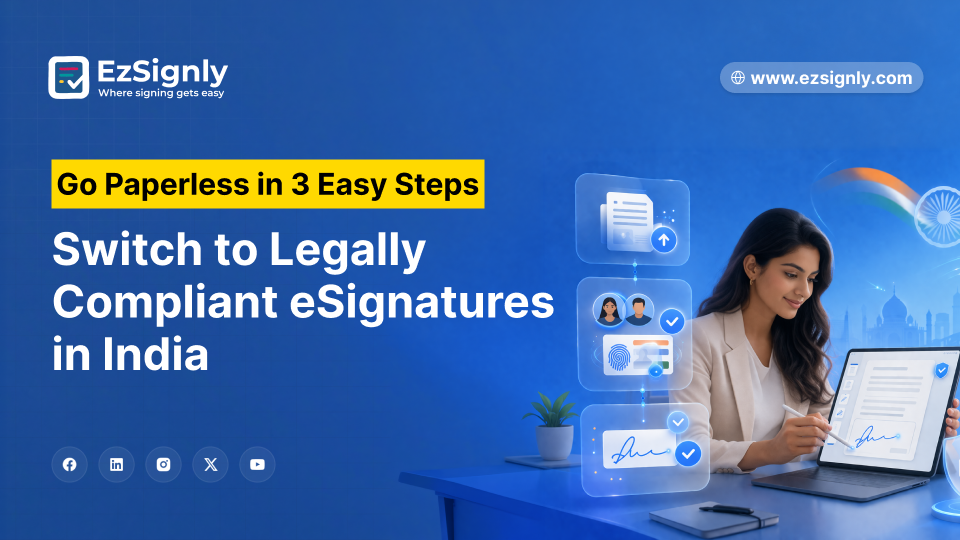
Go Paperless in 3 Easy Steps – Switch to Legally Compliant eSignatures in India
April 8, 2026 | Posted By Admin
E-signature Tool For Legal Documents
Summary
Indian legal departments spend lakhs annually on printing, couriers, and physical storage for documents that could be signed, verified, and archived digitally in minutes. This guide breaks down how the IT Act 2000, Section 65B of the Indian Evidence Act, and global standards like ESIGN and UETA give electronic signatures full legality as wet ink and how AI-powered signing platforms eliminate the administrative friction that keeps law firms tied to paper.
A senior partner at a litigation firm in Delhi spent 45 minutes last Tuesday chasing a client's signature on a settlement agreement. The document had been couriered three days earlier. The client's office confirmed delivery but could not locate the envelope. A second copy was printed, sent by cab across Delhi, signed, and returned. Total cost: ₹1,200 in transport, 3.2 billable hours, and a four-day delay on a matter where a limitation was ticking.
That is not a bad week. That is a Tuesday.
Indian law departments operate inside a system built around physical signatures, stamped affidavits, and notarized originals. Courts demanded paper. But the law moved years ago. The IT Act of 2000 granted electronic signatures legal recognition.
Section 65B of the Indian Evidence Act established the
evidentiary framework for electronic records. Yet firms still print and courier
because most digital signing tools were built for speed, not evidence. A paperless signing tool in India designed for legalized work does not just capture a
signature. It builds a forensic record of every interaction, from the moment
the signer opens the link to the final cryptographic seal.
The Hidden Cost of Paper in Indian Legal Practice
Start with the signature chase. A partner billing at ₹8,000 per hour spending 30 minutes tracking a signature loses ₹4,000 on administration. Across 15 documents weekly, a five-partner firm bleeds ₹3 lakh annually in lost billings before printing costs enter the picture.
Version control is the silent risk. A client signs an old draft because the revised version arrived four hours later. Two conflicting copies now exist, and the firm faces a malpractice exposure it created by not controlling the signing environment. An electronic signature tool for law departments eliminates version drift by presenting only the current document inside a controlled session.
Physical signatures carry an evidentiary weakness attorneys know but rarely discuss. A wet-ink signature proves someone held a pen. It cannot prove when, where, or whether the signer read the document. Platforms offering esignature tools with audit trails and compliance produce timestamped, IP-tagged records that shift the burden of proof.
Storage compounds the drain. A Mumbai-based mid-sized company, currently spending between ₹2.4 lakh and ₹5 lakh each year on physical archiving, could access those same files digitally in a matter of seconds.
Compliance hinges on three key statutes.
- Section 5 of the IT Act 2000 gives electronic signatures the same weight as their handwritten counterparts.
- Section 67A goes a step further, assuming an electronic signature's validity unless the opposing party can prove otherwise. To grasp E-Signature Law in India, one must understand this presumption of validity and the fact that the onus is on the person disputing it.
- Section 65B of the Indian Evidence Act governs the admissibility of electronic records. The Supreme Court's 2014 ruling in Anvar P.V. v. P.K. Basheer confirmed Section 65B compliance is mandatory. Platforms built for eSignature compliance generate completion certificates and audit logs satisfying these requirements automatically.
For companies involved in international arbitration or cross-border transactions, compliance with the ESIGN Act and UETA applies to US-based transactions, all managed within the same system. When firms compare eSignature software pricing in India with the costs of keeping separate signing processes for domestic and international needs, they often discover that consolidation is more cost-effective than the subscription itself.
The burden-of-proof shift is the real advantage. Under
Section 67A, when a document carries a verified electronic signature with a
complete audit trail, the person denying it must prove forgery. With wet
ink, the firm bears the burden through handwriting experts and testimony. A
compliant platform flips the courtroom dynamic before any dispute begins.
How AI is reshaping Document Management in Legal Industry
AI field placement technology now automatically interprets contract structures, pinpointing signature blocks, date fields, witness lines, and initial markers. Take a 22-page share purchase agreement, for instance. The engine quickly identifies the execution pages, detects witness sections, and populates every field in a mere 40 seconds. A paralegal, accustomed to spending eight minutes per document, can now watch the same task conclude before they've even finished their tea.
Automated clause analysis catches what paralegals miss: witness signatures on affidavits, notarization placeholders on powers of attorney, and initial lines on schedules. A missed field sends the entire document back, adding days. Firms tracking "Not-In-Good-Order" rates see a 90 percent reduction when AI validation catches gaps before the signer receives the link.
Identity intelligence adds a verification layer paper
cannot replicate. Multi-factor authentication confirms signer identity through
email, SMS, or biometric checks before the signature event. The authentication
record becomes part of the evidentiary package. The future of eSignature for
legal practice is not faster signing. It is a signing event that builds the
forensic proof a court requires.
How eSignatures Help Major Industries in India
Real estate professionals deal with sale agreements, lease deeds, and title transfers, where the speed of execution can make or break a deal. Picture a property transaction: four parties, each signing sequentially in a single session, instead of a week of back-and-forth courier exchanges.
The best eSignature solutions for real estate professionals route documents through each party in order with a complete audit trail.
Corporate HR departments manage employment contracts, NDAs, and policy acknowledgements at volumes making paper unsustainable. A company onboarding 40 employees quarterly sends 200 to 480 documents through the signing cycle. eSignature software for businesses handling bulk documentation at the base tier replaces the coordinator spending days assembling paper packets each hiring wave.
FinTech and banking sectors rely heavily on immediate
actions, whether it's approving loans, fulfilling KYC requirements, or opening
new accounts. For the law industry, where compliance is paramount, auditable
records transform eSignature infrastructure into a licensing requirement.
Security: Audit Trails, Tamper Evidence, and Encryption
Audit trails meticulously record each interaction. This includes the document opened, complete with a timestamp, the originating IP address, and the device used. Every page viewed is logged. Signatures are applied, with the authentication method and geolocation also recorded.
Firms requiring e-signature tools with audit trails and compliance controls get this record attached permanently to the signed file.
Tamper evidence uses cryptographic hashing to seal documents at signing. If a single comma changes after execution, the hash breaks and alteration is visible. The digital equivalent of a broken wax seal, except mathematically provable.
256-bit AES encryption protects documents at rest. TLS
1.3 secures transit. Role-based access controls restrict visibility to
authorized users. For privileged communications, this standard exceeds anything
a physical courier provides.
Have any other questions? EzSignly's team is here to help!
Three Easy Steps to Go Paperless
Step 1: Upload. Begin by taking your current templates - engagement letters, NDAs, settlement agreements - and uploading them. The AI quickly analyses the document structure, setting up signing fields in a matter of seconds. Cost-effective eSignature software in India handles template preparation at the base tier without per-template charges.
Step 2: Verify. Configure multi-factor authentication. Email verification for standard correspondence. SMS codes for high-value contracts. The authentication method becomes part of the audit trail, strengthening the evidentiary record.
Step 3: Execute. Send
the document. The signer authenticates, reviews, and signs from any device. The
platform generates a completion certificate with timestamps, authentication
records, and a tamper-evident hash. EzSignly's 90-day free trial lets firms
test the workflow with real client documents before committing a budget.
Conclusion
The lawful framework is well-established. Section 65B of the IT Act, along with twenty years of court decisions, confirms that electronic signatures are as legally valid as traditional signatures, provided the platform provides the evidence required by the courts.
EzSignly’s eSignature software for legal teams gives Indian law departments AI-powered document preparation, court-admissible audit trails, dual compliance, sequential signing, and a 90-day free trial starting at ₹449 per user monthly. Every week spent chasing physical signatures is a week of billable hours that a three-step digital workflow recovers permanently.
FAQs
1. Are electronic signatures legally valid for Indian documents?
Section 5 of the IT Act 2000 gives electronic signatures the same legal standing as handwritten ones. The Indian Evidence Act's Section 65B governs how electronic records can be used in court. Additionally, Section 67A states that the person who disputes the electronic signature must prove their case.
2. How does compliance work for firms with international clients?
Platforms with dual IT Act and ESIGN Act compliance cover domestic Indian transactions and cross-border work with US-based clients under one workflow. Firms handling international arbitration get a single platform for both jurisdictions.
3. What security features should Indian legal teams look for?
Legal-grade platforms include 256-bit AES encryption, TLS 1.3, multi-factor authentication, tamper-evident cryptographic hashing, forensic-level audit trails, and role-based access controls. The completion certificate should travel permanently with the signed document.
4. How does AI reduce document preparation time?
AI reads document structure, identifies signature blocks, date fields, and witness lines, and places every field automatically. A 22-page agreement taking eight minutes manually ships in under a minute. Across 300 monthly documents, that recovers 30 to 40 hours of paralegal time.
5. What does eSignature software pricing in India look like for legal departments?
eSignature software pricing in India for legal-grade platforms starts at ₹749 per user monthly with 360 documents, audit trails, templates, and IT Act compliance. A 10-user department pays ₹89,880 annually compared to ₹3 lakh or more on enterprise platforms.
Take a look at the latest blog
HR Workflow in India Trends Driving eSignature Adoption with EzSignly: Book a Demo
Discover how evolving HR workflows in India are driving eSignature adoption. Book a demo to see how EzSignly simplifies hiring, onboarding, and docume...
June 12, 2026
Best eSignature Software Security and Automation Features for Indian Modern Businesses
Secure, compliant eSignatures with smart automation for faster business workflows.
March 18, 2026
Free vs Paid HR eSignature Software: Get Complete Insights for Your Business: Signup Now
To choose which HR eSignature software is ideal for your company, compare free and premium options. To receive comprehensive insights, register now.
July 24, 2026
Solve Document Workflow Management With AI e-Signature Features: Try Free Trail
Simplify document workflows with AI-powered e-signatures. Sign, send, and manage documents faster. Start your free trial today.
June 19, 2026
Have any other questions? EzSignly's team is here to help!
© 2026 Copyright EzSignly. All Rights Reserved