


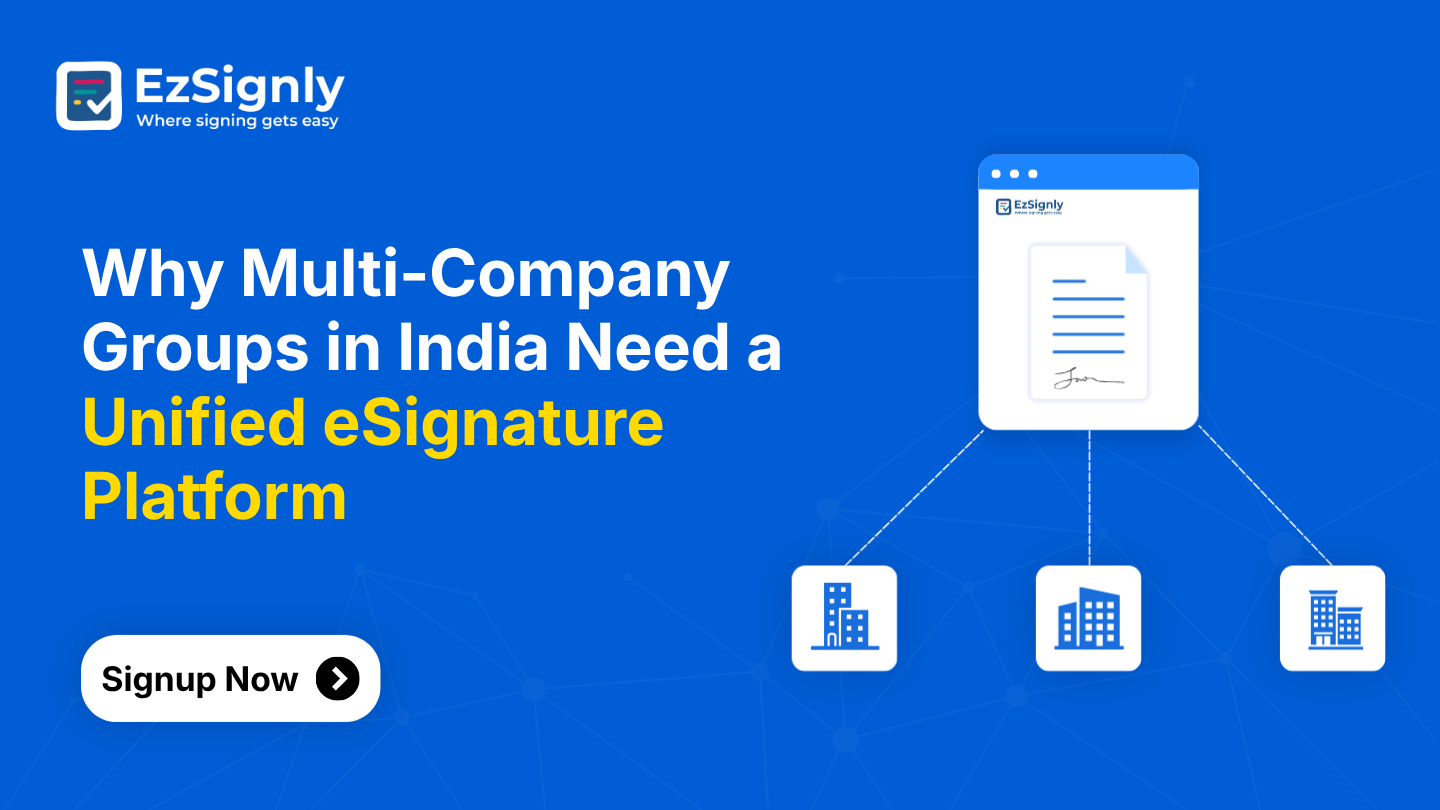
Why Multi-Company Groups in India Need a Unified eSignature Platform: Signup Now
July 23, 2026 | Posted By Admin
Electronic Signing Software
Summary
Operating multiple entities as a group frequently
equates to wrestling with different credentials, fractured agreements, and
fragmented workflows. Implementing a central e-signature platform brings your
entities onto one portal, minimizes administrative burden, and keeps every
business's documentation audit-ready. For an Indian business group aiming to
scale both vertically and horizontally, this change is more of a business
imperative than a choice, as it is essential to remain agile and compliant.
Introduction
Indian business groups rarely stay small for long. A
textile house adds a logistics arm, a real estate developer floats a separate
entity for every project, and a family-run business incorporates a new private
limited company each time it enters a fresh market. On paper, this structure
makes tax and liability sense. In practice, it creates a documentation headache
— HR letters for one entity, vendor contracts for another, and board
resolutions for a third, all signed, tracked, and stored in different silos.
This is exactly the gap eSignature software for
multi-company in India is built to close. Instead of maintaining
separate signing tools or logins for each subsidiary, a group can run all of
its paperwork through one secure, centrally governed system, without losing the
individual identity of each company.
Streamline Document Management Across Multiple Entities
Ask an operations leader in any multi-group company about how contracts are typically signed, and you'll hear the same tale: a PDF sent by someone in finance; offer letters printed out, scanned, and pursued for a wet ink signature by HR due to courier delays; and finally followed up with legal as a director disappears. Extend that across five, ten, or fifteen different group entities, and the inefficiency compounds. Delays to approvals mount, audit trails vanish, and there is no holistic view of the status of group projects.
On top of that, you develop an invisible, longer-term
concern: knowledge silos. If every subsidiary has its own process of signing
and archiving documents, no one in the headquarters will ever be able to answer
a simple question like, "How many vendor agreements have we got on our
signature schedule this month across the entire group?" without mailing
half a dozen teams and waiting for their answers. With a central signature
process, the fragmentation dissolves. The appropriate user can sign and send
documents for any subsidiary on a single, central dashboard, ending
time-consuming communication loops and providing leadership with instant
visibility, not outdated ones.
One Login for Seamless Multi-Company Management
One of the biggest wins of a unified platform is doing
away with separate credentials for every company under the group. Instead of
logging in and out of different accounts to send an NDA for the manufacturing
unit and an offer letter for the services arm, a master login lets teams switch
between entities instantly. This isn't just a convenience feature — it directly
reduces password fatigue, lowers the risk of shared or forgotten logins, and
gives group leadership a consolidated view of document activity across the
entire business empire. For CFOs and compliance heads managing multiple GSTINs
and PANs under one holding structure, this single point of control is
invaluable.
Unified Compliance and Security for Every Group Company
Multi-company groups in India must follow many
statutory obligations, including GST filings for each entity, ROC compliance,
and sector-specific regulations that vary by business line. When signing tools
are everywhere, it is difficult to keep track of who signed what and when
during audits. With an eSignature platform, you can ensure that all your
subsidiaries have consistent OTP-based identity checks, tamperproof audit
trails, and consistent encryption standards – none left vulnerable. Your
documents remain IT Act compliant, all actions time-stamped and verifiable. You
will be glad to hear that your statutory audits will now be much smoother.
Groups evaluating their options can also check eSignature software
pricing in India to see how consolidated plans compare against paying
separately for each entity.
Grow Your Business Faster With Smarter Cost Control
Paying separately for each subsidiary, whether per
document or per user, can quickly become expensive and complicate budgeting for
finance teams managing group-level P&Ls. A shared signing pool changes this
equation. Instead of five different subscriptions with five different renewal
dates, a multi-company plan pools sign requests and templates across all
entities, so usage from a quieter subsidiary can offset a busier one in the
same billing cycle. This predictability matters most for MSMEs and growing groups
that are scaling new entities regularly but don't want signing costs to scale
unpredictably alongside them. It also simplifies vendor management for
procurement teams, since there's just one invoice and one renewal to track
instead of a dozen.
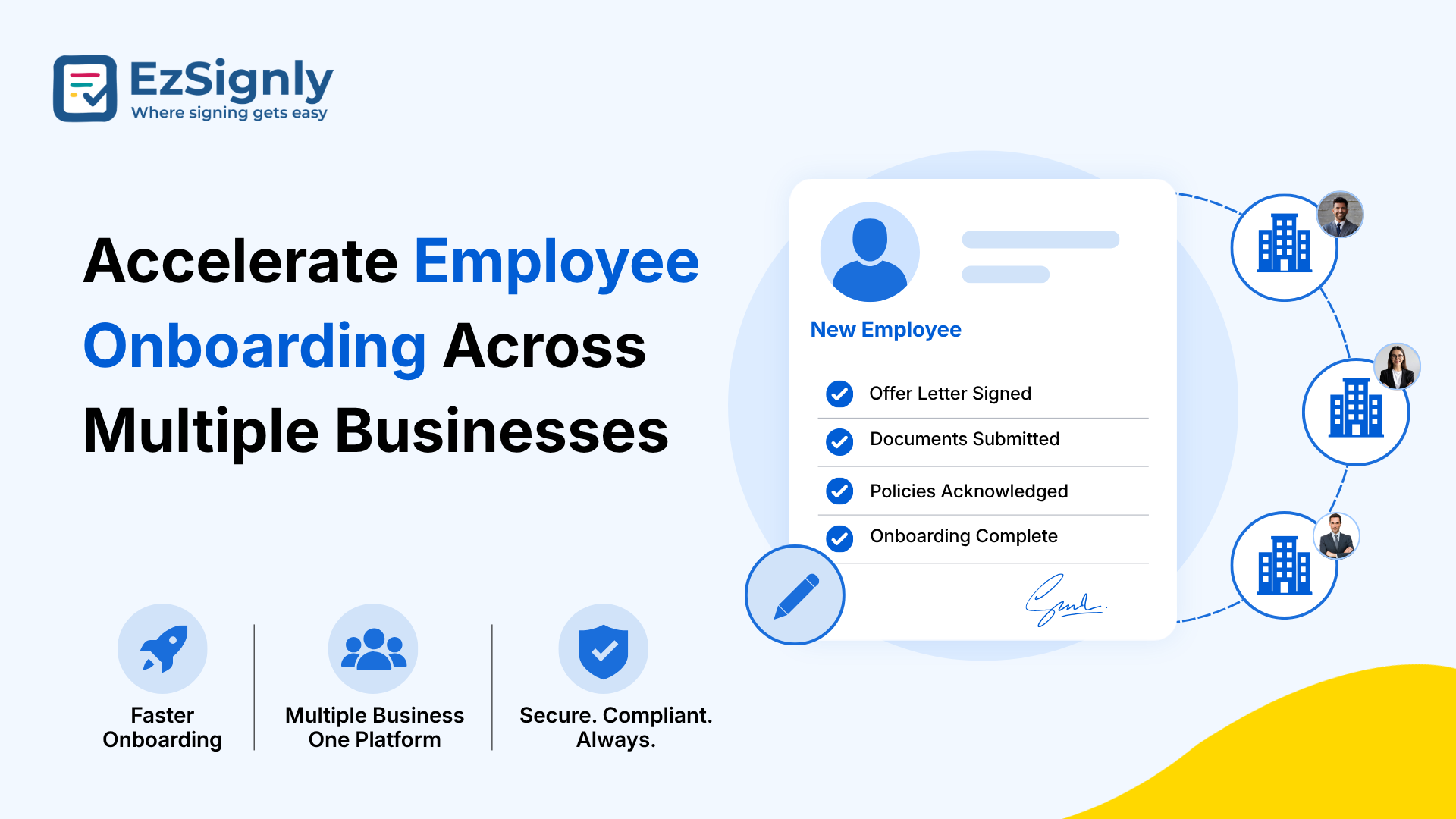
Accelerate Employee Onboarding Across Multiple Businesses
Corporate HR functions regularly support recruiting,
hiring, and terminations for a whole group of companies. They can even move
people from one entity to another as the company reorganizes. New hires won't
wait if you're sending offer letters, appointment letters, policy acceptances,
and NDAs in pieces to several different places and at a different pace,
especially for a first job! Instead, a single platform allows the group HR team
to produce and send all of these documents out to any of the subsidiaries from
a single dashboard, monitor pending signatures and save signed copies in one
place instead of on various hard drives and inboxes. Teams exploring this area
for their people functions can look at options built specifically as eSignature
software for HR in India to see how bulk sending and templates apply
to onboarding at scale.
Best Electronic Document Signing
Improve Contract Consistency with Streamlined Approvals
Each subsidiary maintaining their templates, contract
wording, and approval workflows inevitably leads to disparities in consistency
and potential legal misalignment within the group. A centralized platform lets
legal and compliance teams push standardized templates for vendor agreements,
leases, and NDAs to every entity, while still allowing entity-specific
customization where needed. Sequential signing ensures that approvals follow
the correct hierarchy — say, department head, then finance, then director —
without anyone having to chase the next signatory manually. This kind of
standardization protects the group from the risk of an outdated clause slipping
into one subsidiary's contract while the rest of the group has already updated
it. Business owners scaling across sectors can review dedicated eSignature
software for business in India, which is set up to help them understand how
templates and role-based access work together at a group scale.
One Smart Solution for Multiple Company Workflows
This is precisely the gap EzSignly's Multi-Account Hub
is designed to close for Indian business groups. Rather than treating each
subsidiary as a separate customer, EzSignly lets a parent organization manage
multiple companies from one master dashboard, with instant account switching,
shared templates, and unified audit trails across every entity. Group plans in
India support up to 3 companies and can scale to unlimited entities for larger
holding structures, with OTP verification and role-based access control
included as standard, not as an add-on. For a business house that has outgrown
single-entity signing tools, EzSignly's group plans offer a practical middle
ground between fragmented free tools and expensive, over-engineered enterprise
software.
Have any other questions? EzSignly's team is here to help!
Conclusion
Managing paperwork across a multi-company group doesn't have to mean managing chaos. A consolidated signing platform brings together all agreements, approvals, and compliance documentation for all subsidiaries into a single controlled system, while ensuring that each entity keeps its unique identity. This consolidation saves actual time, strengthens security, and eliminates compliance audit nightmares for Indian companies expanding in new industries and geographies. The groups that make this shift now will simply run leaner than the ones still juggling five different logins.
🚀Are
you ready to bring every company in your group under one secure dashboard? Sign
up now
FAQs
Q: Can one platform really handle compliance for multiple separate companies?
A: Yes. Each entity's documents, templates, and audit trails stay distinct within the platform, even though users access them through one master login. This keeps statutory records for each company separate while still giving group leadership a consolidated view of activity across the business.
Q: Is switching between company accounts secure, or does it increase risk?
A: A well-built multi-account system actually reduces risk. Instead of employees reusing weak passwords across separate tools for each entity, they are replaced by a single set This system uses verified credentials with role-based permissions to control exactly who can access each subsidiary's documents, supported by OTP verification and encryption.
Q: Do smaller group companies still get full features, or only the parent entity?
A: No, features like bulk sending, templates, and tracking apply uniformly across every subsidiary on the plan. Sign request pools are shared across the group, so smaller entities aren't limited just because they generate fewer documents than the parent company.
Take a look at the latest blog
eSignature Software Automation Guide for Business Operations – Get a Free Trial Today
Automate contracts and approvals with eSignature software. Start your free trial today.
April 14, 2026
Stop Losing Time: How eSignatures Helps Businesses to Save Money in India: Signup Now
Save time and reduce paperwork costs with secure eSignatures. Sign documents online anytime, anywhere in India.
June 19, 2026
eSignature Is Revolutionizing in HR Business with Automation Features in India: Book a Demo
HR processes can be automated using secure eSignatures. Increase productivity, cut off paperwork, and save time. Book a demo right now.
July 21, 2026
HR Workflow in India Trends Driving eSignature Adoption with EzSignly: Book a Demo
Discover how evolving HR workflows in India are driving eSignature adoption. Book a demo to see how EzSignly simplifies hiring, onboarding, and docume...
June 12, 2026
Have any other questions? EzSignly's team is here to help!
© 2026 Copyright EzSignly. All Rights Reserved