


eSignature Compliance Guide: Legal & Security Rules for USA & India Businesses
April 14, 2026 | Posted By Admin
Best E-signature Software
Summary
Legal teams in the USA and India need to know what
actually makes an eSignature hold up in court. This guide covers the specific
laws, the security standards regulators expect, and the practical steps to get
your signing workflows compliant without overcomplicating things.
Table of Contents
- Why eSignature Compliance Matters for Legal Teams in 2026
- eSignature Laws in the USA: ESIGN Act & UETA Explained
- eSignature Laws in India: IT Act, Digital vs Electronic Signatures Explained
- How to Build a Legally Compliant eSignature Workflow Step by Step
- eSignature Compliance Requirements by Industry (HR, Legal, Finance, Healthcare)
- Practical Steps You Can Take This Week
- Conclusion
- FAQs
Why eSignature Compliance Matters for Legal Teams in 2026
Most companies adopt e-Signatures for speed. Few stop to check whether their process actually meets legal requirements in the countries they operate in.
That gap creates real problems. Contracts get challenged. Regulators ask questions. Legal teams spend hours fixing something that should have been set up correctly from the start. According to industry data, over 80% of enterprises use digital document workflows now, but a large portion of them still lack proper audit trails or consent mechanisms. The issue gets worse when you pick up a paperless signing tool based on marketing claims alone and skip the compliance part. A signed PDF means very little if you cannot prove who signed it, when they signed it, and whether they agreed to sign electronically in the first place.
This guide is for law departments that need real
clarity. It covers what best practices for e-Signature compliance
actually look like, how to e-sign contracts that will hold up under scrutiny,
and what differs between US and Indian law. No theory. Just what you need to
know.
eSignature Laws in the USA: ESIGN Act & UETA Explained
The ESIGN Act and UETA
Two laws do the heavy lifting here.
The ESIGN Act (2000) is the federal law. It says electronic signatures and records are just as valid as paper ones for interstate and foreign commerce. The UETA covers state-level transactions and has been adopted by almost every state.
Neither law tells you which software to use. They care about outcomes. Did the person intend to sign? Did they consent to doing it electronically? Can you prove it? To make a signature legally binding and secure under these laws, your process needs five things:
- Intent to sign: The person clicked a button, typed their name, or drew a signature. Something deliberate.
- Consent to go electronic: Before signing, all parties agreed to use electronic records.
- Signature tied to the document: The signature has to be connected to that specific file, not floating separately.
- Records kept properly: You need to store the signed document and its metadata so it can be pulled up accurately later.
- Option to use paper: Signers can still request paper copies or withdraw electronic consent.
State Differences
ESIGN and UETA set the floor, not the ceiling. Some
states add their own rules. If your team is looking for HR online signature
software in Illinois, check that the platform meets the Illinois Electronic
Commerce Security Act too. It has extra requirements around digital
certificates for certain transaction types. Do this before you roll anything
out, not after.
eSignature Laws in India: IT Act, Digital vs Electronic Signatures Explained
The Information Technology Act, 2000
India separates electronic signatures into two buckets, and mixing them up causes problems.
- Digital Signatures (Section 3). These use PKI cryptography and need a Digital Signature Certificate from a government-licensed Certifying Authority. You must use these for regulatory filings, government submissions, and high-value financial deals.
- Electronic Signatures (Section 3A). This is the broader category. It includes Aadhaar eSign (OTP or biometric-based). For most everyday business contracts, companies use this. It carries the same legal weight as a handwritten signature.
- Section 5 of the IT Act says electronic signatures are lawfully equivalent to physical ones. Section 10A says contracts formed electronically are enforceable.
Here is where cost comes in. When companies research digital
sign PDF pricing in India, many do not realize the price depends on which
type of signature they need. Basic electronic signatures for standard contracts
cost far less than Class 3 DSC-backed digital signatures for regulated filings.
Pick the wrong one and your agreements may not be enforceable.
How to Build a Legally Compliant eSignature Workflow Step by Step
Knowing the law is only useful if your internal process reflects it. Most platforms marketed as the best e-Signature solutions for legal professionals will handle parts of this automatically, but your team still needs to verify what is actually happening under the hood.
Why Audit Trails Are Critical for e-Signature Compliance
This is the part that matters most in a dispute. An audit trail logs every action on a document: who opened it, when they authenticated, what device and IP address they used, when they signed, and what happened after. Courts treat audit trails as forensic evidence. Legal teams that use e-Signature tools with audit trails and compliance features have a clear advantage when a signatory claims they never signed or did not understand what they agreed to. Without a proper trail, you are relying on someone's word against another person's word.
What your audit trail needs to capture:
- How the signer verified their identity (email link, MFA, biometric, government ID)
- Timestamps for every action, not just the signature
- IP address and device details
- Whether the document was altered after signing
- Proof that the final copy was delivered to all parties
Encryption Standards for Legally Binding eSignatures
Every signed document should be encrypted in transit and at rest. AES-256 for storage, TLS 1.2 or higher for transmission. If you handle health data (HIPAA), personal data under GDPR, or data covered by India's Digital Personal Data Protection Act, encryption is not a nice-to-have. Regulators expect it.
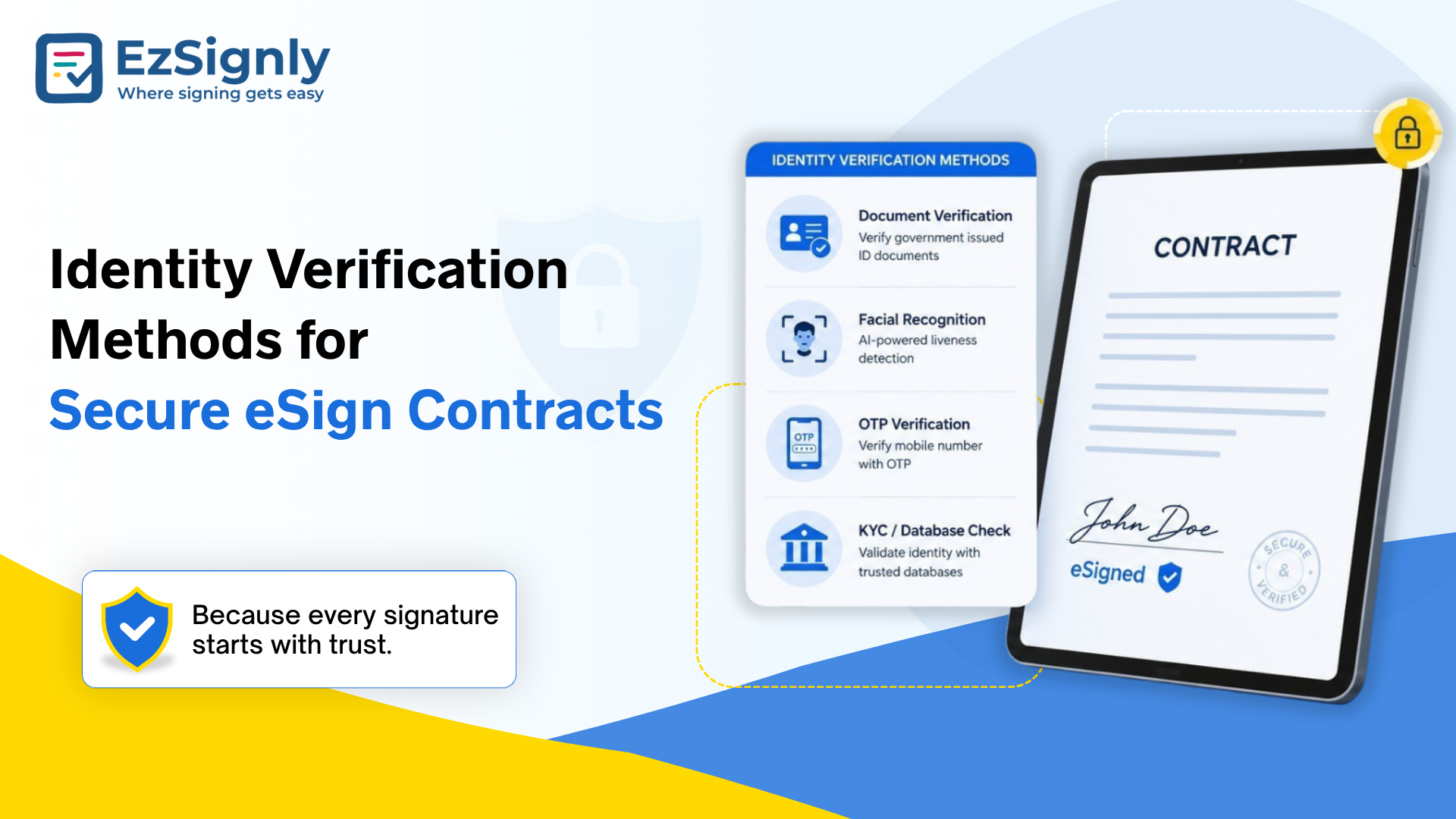
Identity Verification Methods for Secure eSign Contracts
Not every document needs the same level of verification. An internal policy acknowledgment is different from a cross-border acquisition agreement. Use email authentication for low-risk documents. Use multi-factor authentication, government ID checks, or PKI-based signing for anything high-stakes.
Set up role-based access controls so only the right
people can view or manage signed files. This is basic hygiene, but a surprising
number of teams skip it.
Best eSignature Software
eSignature Compliance Requirements by Industry (HR, Finance, Healthcare)
Compliance is not one-size-fits-all. The regulatory bar shifts depending on what your company does, and e-Signatures compliance obligations vary across sectors:
Healthcare: HIPAA applies in the US. Your platform must encrypt audit logs and protect patient data. Consent forms, treatment authorizations, and telehealth documents all fall under these rules.
Financial services: SEC, FINRA, and RBI (in India) set strict retention and authentication standards. Loan documents, account openings, and disclosures signed electronically need to meet those thresholds.
Real estate: Many states require notarization for property transactions. Remote online notarization is now accepted in several jurisdictions, but only through compliant platforms.
HR: Offer letters, NDAs,
employment contracts, and policy sign-offs are straightforward candidates for
e-Signatures. The key is choosing a platform that does not create compliance
gaps at scale.
Have any other questions? EzSignly's team is here to help!
Practical Steps You Can Take This Week
You do not need a six-month project to get this right. Start here:
Check your current process. Walk through a recent signing workflow and see if it captures intent, logs consent, and retains records properly. Most gaps show up fast.
Sort your documents by risk. High-value contracts need stronger authentication than internal memos. Treat them differently.
Verify your platform's certifications. SOC 2 Type II certification and ISO 27001 are the minimum. If your vendor cannot show these, that is a red flag.
Train your people. It does not matter how good the platform is if staff skip steps or misuse features. Short, regular training sessions work better than a one-time onboarding deck.
Set retention rules. Know how long your industry requires you to keep signed documents. Build that into your archival process.
Ask your vendor tough questions. Do they run
penetration tests? How do they handle breaches? Where is your data stored? If
they are vague, look elsewhere.
Conclusion
Compliance is not a feature you add later. It needs to be part of how you set up eSignatures from the start. The organizations getting this right are the ones that treat eSignatures compliance as an operational standard, not an afterthought. They pick platforms with real audit trails, verify encryption, and train their teams on what the law actually requires.
The laws in both the US and India are clear: demonstrate intent, record consent, maintain audit logs, encrypt data, and keep everything accessible for as long as regulators say you should. None of this is complicated. It just needs to get done.
Ready to see it in action? Start a Free Demo and find out how EzSignly handles every part of this for your team.
👌Get a 90-day FREE trial and explore the unending business growth!
FAQs
Q1. What makes an eSignature legally binding in the USA and India?
Ans: In the USA, the ESIGN Act and UETA require proof of intent, consent to electronic transactions, the signature linked to the document, and proper record storage. In India, the IT Act says the signature must be tied to the signer, under their control, and any changes to the document after signing must be detectable. Both countries treat compliant eSignatures the same as handwritten ones.
Q2. Why do audit trails matter so much?
Ans: Because they are your proof. An audit trail records who signed, how they verified their identity, what device they used, and exactly when each action happened. If someone challenges a contract, the audit trail is what you show a court. Without one, you have no evidence.
Q3. Should I use electronic signatures or digital signatures for contracts in India?
Ans: For most business contracts, electronic signatures under Section 3A (including Aadhaar eSign) are enough. Digital signatures under Section 3, which need a Digital Signature Certificate from a licensed authority, are required for government filings and regulated transactions. Use the type that matches your regulatory obligation.
Take a look at the latest blog
eSignature Software Automation Guide for Business Operations – Get a Free Trial Today
Automate contracts and approvals with eSignature software. Start your free trial today.
April 14, 2026
The Ultimate Guide to Secure & Automated eSignatures for Faster Business Growth — 2026
Secure automated eSignatures to sign faster, save time, and grow your business in 2026.
April 16, 2026
Top Reasons to Adopt Electronic Signatures in Your Company – Start Your Free Trial
Boost speed, security, and productivity with electronic signatures. Switch to EzSignly and simplify signing workflows. Start your free trial today.
April 20, 2026
How eSignature Software Can Boost Your Business to the next level in India: Book a Demo
Boost your business with secure, paperless eSignatures in India—streamline approvals, save time, and accelerate growth. Book a demo today
July 16, 2026
Have any other questions? EzSignly's team is here to help!
© 2026 Copyright EzSignly. All Rights Reserved