


From Paper to Digital: Why Your Business Needs E-Signatures for Legal Documents
April 15, 2026 | Posted By Admin
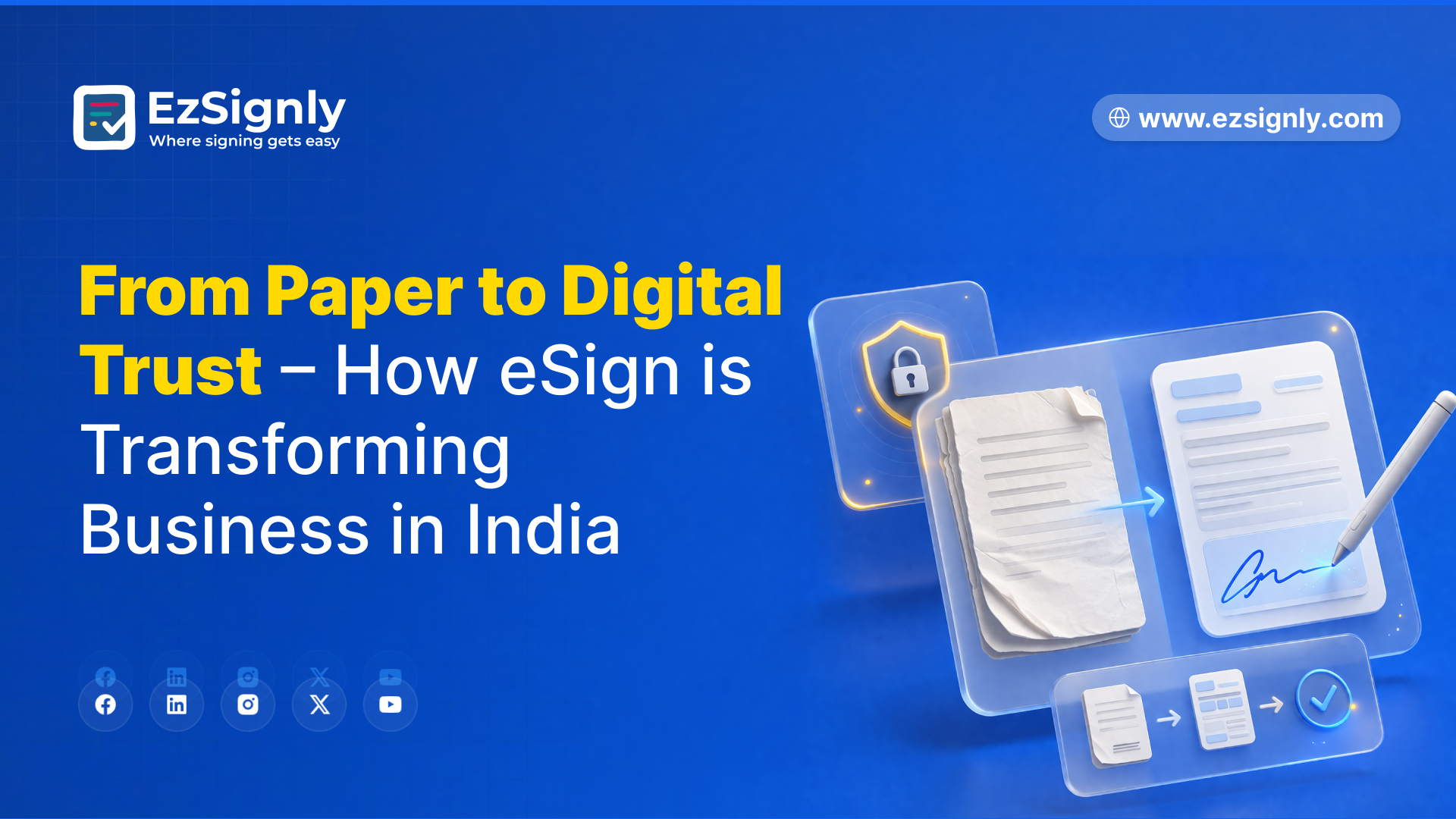
Esignature For Business
Summary
Legal teams everywhere face mounting demands: speedier
deal closures, tighter budgets, and less exposure to compliance issues. This
article explores the powerful reasons for switching to electronic signatures
rather than relying on traditional paper methods. Find out how electronic
signatures can help your company in terms of contracts, compliance, and
ROI.
Introduction: The Paper Problem Nobody Talks About
Consider the following situation: an important corporate contract awaits signing. It's printed, whisked away across two time zones, signed with a flourish, scanned, and then emailed back. Only to be rejected because one person signed on the wrong page.
The deal is delayed by a week. The client is frustrated. Your team is exhausted.
Sound familiar? For law departments globally, it is a Tuesday.
McKinsey's research suggests that companies digitizing their document workflows can slash processing times by as much as 80%, while also cutting document-related expenses by 20 to 30%. Despite these potential gains, numerous teams continue to use outdated paper-based systems. A dependable eSignature platform for business can revolutionize the way you handle contracts – from creation to signature, tracking, and storage. EzSignly is designed with the needs of global teams in mind.
See how EzSignly can transform your legal
workflows from day one. Start a Free Demo!
Why Paper-Based Legal Workflows Are Costing Your Business More Than You Think
Paper-based workflows are expensive, and not just in postage and printing.
Direct costs include:
Expenses for printing, scanning, and physical storage.
Courier and overnight delivery charges.
Staff time dedicated to obtaining signatures and handling revisions.
Overhead associated with physical archiving and retrieval.
Hidden costs include delays of days, or sometimes even weeks, in closing deals, all because of the logistics of getting signatures. Problems with compliance arise when documents are either unsigned or filed incorrectly.
A 2023 Forrester Research study revealed that companies spending over ten hours a week on manual document processes lose, on average, $36,000 annually in productivity for each professional. Hence companies should start thinking about moving from paper to digital signatures in 2026. For mid-to-large departments, these figures escalate rapidly.
Are E-Signatures Legally Valid for Corporate Agreements Worldwide?
This is the objection legal teams most frequently voice, and it's a valid one.
Electronic signatures are legally recognized in over 60 countries, including under the U.S. ESIGN Act (2000), the EU eIDAS Regulation (2016), and India's Information Technology Act (2000). For E-Signatures for Corporate Agreements, the framework is robust, well-tested, and court-admissible in most commercial jurisdictions.
Types of e-signatures you should know:
- Simple Electronic Signature (SES): Suitable for everyday contracts, NDAs, and internal approvals.
- Advanced Electronic Signature (AES): Linked to the signatory's identity, ideal for higher-value agreements.
- Qualified Electronic Signature (QES): The highest standard under eIDAS, equivalent to a handwritten signature in the EU.
If accessed as a legal eSignature software tool download, most enterprise platforms support all three tiers, allowing your team to match the signature type to the document's risk level.
Bottom line: if your concern is enforceability, e-signatures do not just meet the bar. In many cases, they exceed it, with audit trails that paper simply cannot provide.
Key Benefits of E-Signatures for Corporate Agreements and Legal Teams
Contracts that previously took five to seven days to execute via post can be completed in minutes. Many teams start by searching for a paper-to-digital signature-free solution before moving to a full platform. For teams churning through a mountain of agreements each week, this means quicker revenue recognition and happier clients.
Audit trails and compliance are built into every e-signed document. Each generates a secure, tamper-proof audit log. This log records the signer's identity, the date and time of the signature, the originating IP address, and the specific document version that was signed. Being able to track every action taken is a huge asset when dealing with audits, disputes, or even internal assessments.
Security and authentication are absolutely critical. Top-tier platforms offer multi-factor authentication, identity verification, and encrypted document storage. These features far surpass anything paper contracts can provide. For law teams dealing with the intricacies of various jurisdictions, a robust eSignature platform is a must-have. It offers built-in support for local compliance, no matter if your clients are in London, Lagos, or Los Angeles.
Use Cases: E-Signatures Reshaping Legal Operations
Corporate agreements
E-signatures are fundamentally changing the landscape of lawful document management for businesses. They're simplifying the process across the board, encompassing everything from non-disclosure agreements and shareholder resolutions to merger agreements and board consents. Teams benefit significantly from enhanced version control and real-time tracking. This gives them a continuous, unambiguous view of an agreement's present condition.
Vendor and procurement contracts
Digital signatures are a game-changer. They slash procurement cycle times, allowing supplier agreements, MSAs, and SOWs to be sent, reviewed, and signed with remarkable speed. The Bulk Send Feature Overview in India offers a particularly useful tool for teams juggling extensive vendor networks. It lets them distribute the same agreement to hundreds of signatories at once, all while keeping track of each individual's signature.
HR and employment documents benefit greatly from e-signatures. Everything from offer letters and employment contracts to policy acknowledgments and severance agreements is streamlined. E-signatures for HR documents in India are particularly valuable now, given the rise of remote and hybrid work, which often puts physical distance between HR teams and their employees. The onboarding process, once a lengthy affair, is now completed in a fraction of the time.
Filing documents and signature forms are essential for
organizations in strictly regulated industries such as medicine, financial
services, and insurance. Client signature is just part of the process. Digital
signatures provide the documentation required by regulators and are much easier
to locate than traditional paper-based ones.
How to Choose the Right E-Signature Platform
Not all platforms are created equal. Here is what law departments should prioritize when evaluating options.
- Compliance coverage: Does it extend to the areas where you conduct business?
- Security certification: Ensure it has SOC 2, ISO 27001, and GDPR certification.
- Workflow Automation: Does it offer workflow automation for sending the document to multiple stakeholders for signing?
- Audit Trail: Is there a proper audit trail which is complete and tamper-proof?
- Integration: Can it be integrated into your CLM, CRM, and/or HRIS system?
- Scalability: Can it handle your current workload and grow with you?
For teams working in South Asia, figuring out the cost of digital sign PDFs in India is a key part of the process. Pricing in the region can differ quite a bit from what's offered globally. A platform that provides clear, localized pricing makes it easier to get on board.
Take the first step with a live walkthrough tailored to your team's needs. Start Your Free Trial.
Making the Transition: A Practical Implementation Guide
The biggest risk in any digital transformation is not the technology. It is change management. Here is a practical approach for teams.
Phase 1: Assess your document workflows.
Determine the types of documents that take the most effort and time to get completed. Non-disclosure agreements, employment agreements, and vendor agreements often make good places to begin.
Phase 2: Testing with a Single Use Case
Begin by deploying e-signatures for a single document. This first step allows your team to gain experience, uncover any issues, and develop standard operating procedures.
Phase 3: Train and Enable
It's not enough to concentrate solely on your team's training. You also need to equip internal stakeholders. This means providing training for those in procurement, HR, and finance, as they'll be the ones initiating or receiving signature requests.
Phase 4: Measure and Iterate
Monitor the key performance indicators closely. This
means tracking average signing time, completion rates, and document turnaround.
You'll need to compare these figures from before the new system was put in
place with those after.
Have any other questions? EzSignly's team is here to help!
Conclusion
Law departments globally are at a turning point. The tools exist, the frameworks are in place, and the business case is overwhelming. Paper-based processes are more than just inefficient; they are a major problem in today's world, which requires speed, security, and the ability to grow. E-signatures prove their worth across the board. They speed up everything from corporate agreements to HR onboarding, and the advantages are clear. If your team accesses a legal eSignature software tool online, the path from paper to digital has never been more accessible. The question is not whether your law department should adopt e-signatures. The question is: how much longer can you afford not to?
You can explore this further with a Start a Free Demo option tailored for growing teams.
Frequently asked questions
Q1: Are e-signatures legally valid for all types of corporate agreements?
Ans: Yes, electronic signatures hold legal weight. They're accepted for a broad range of business documents, including non-disclosure agreements, service contracts, employment agreements, and vendor contracts. However, some document types, such as wills or real estate transactions, might still necessitate traditional, handwritten signatures in certain areas.
Q2: How secure are e-signatures compared to wet-ink signatures?
Ans: E-signatures generally offer better security than traditional signatures. The most secure e-signature platforms use end-to-end encryption, require multi-factor authentication, and create a detailed audit trail. The trail includes timestamps, IP addresses, and document hashes. In contrast, wet ink signatures lack this kind of metadata.
Q3: How long does it take to implement an e-signature solution for a legal department?
Ans: For most teams, the initial setup period typically spans two to four weeks. This timeframe, however, is subject to variation, particularly depending on the complexity of integrating with existing systems. Fortunately, most platforms offer dedicated onboarding support to expedite the process.
Take a look at the latest blog

Common E-Signature Mistakes (And How to Avoid Them)
An e-signature is a promise. But a simple mistake can make that promise legally worthless. I’ve seen businesses lose deals over errors that were easil...
December 31, 2025
E-Signatures Help Faster Deals for Smart Business Growth in 2026
E-signatures speed up document approvals, reduce paperwork, and improve efficiency—helping businesses close deals faster and grow smarter in 2026.
February 16, 2026
One-Click AI Filling: How eSignatures Transform Document Preparation
One-click AI filling automatically completes documents with accurate data, enabling faster preparation and instant eSignatures.
March 24, 2026
From Hours to Minutes: How eSign Transforms Law Firm Client Signing Workflows
eSignatures cut signing time from hours to minutes, enabling faster, seamless client approvals.
March 27, 2026
Have any other questions? EzSignly's team is here to help!
© 2026 Copyright EzSignly. All Rights Reserved