


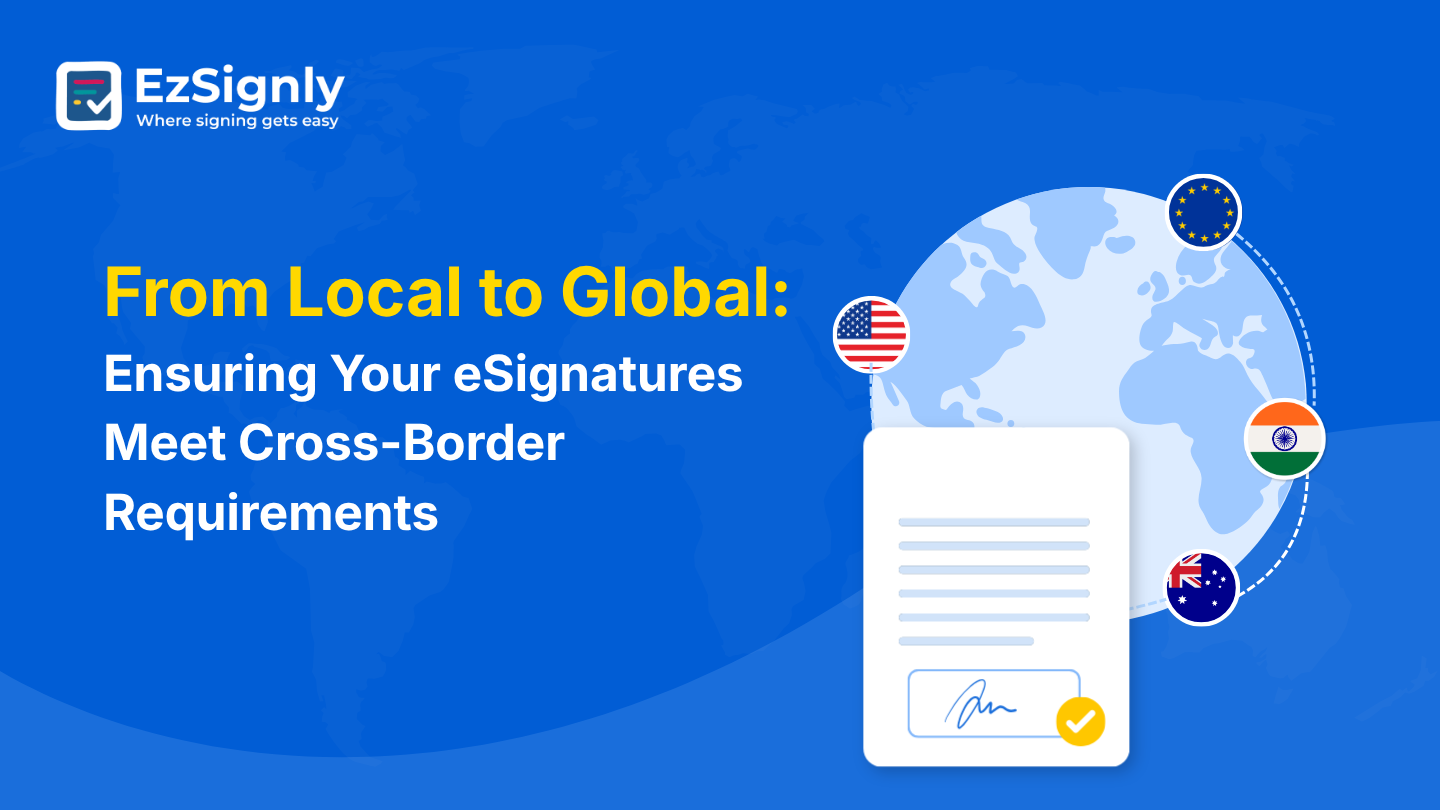
From Local to Global: Ensuring Your eSignatures Meet Cross-Border Requirements
August 14, 2026 | Posted By Admin
secure document signing
Summary
When U.S. businesses sign contracts with people in other countries, a basic e-signature usually isn't enough. They also need to think about the laws of the other country, make sure they know who is really signing, get clear agreement from that person, keep good records of how the signing happened, protect any personal data involved, and make sure the documents can't be changed or tampered with after signing. Here's how to build a trustworthy digital signing process that works for international deals while staying compliant.
Introduction
For a growing U.S. business, signing a contract with someone in another country — a customer, employee, supplier, or partner — can seem like just another everyday task. But once a document crosses international borders, the rules for electronic records and signatures get more complicated. A signing method that works fine for a domestic deal won't necessarily meet the legal requirements of another country. This is why picking the right eSignature software for businesses in Chicago — or anywhere else in the U.S. — matters more than just convenience. Companies need a system that clearly gets each signer's agreement before they sign, makes sure the document can't be altered once it's signed, checks that the signer is really who they say they are, stores the signed records safely and properly, and provides solid proof that the signing actually happened.
Global eSignature Compliance Made Simple for Businesses
Domestic signing and international signing may look identical on the screen, but the legal environment behind them can be very different. In the United States, electronic transactions are supported by federal and state frameworks, including the Electronic Signatures in Global and National Commerce Act and state electronic transaction laws. Different countries may set their own rules for identity verification, consent, document retention, electronic records, or signature types.
For example, the European Union has its own rules for electronic signatures called eIDAS. Other countries follow laws based on the UNCITRAL Model Law on Electronic Signatures, which has been adopted, in some form, in dozens of countries around the world. This means a U.S. company can't assume that a signature valid in the U.S. will automatically be valid everywhere else.
Instead, businesses should look at where the parties are located, what kind of deal it is, what type of document is involved, and whether the industry has special rules — before deciding how they will handle signatures.
The Five Building Blocks of a Cross-Border Signing Process
A reliable international document workflow starts with evidence. The more clearly a company can demonstrate what happened during the signing process, the easier it becomes to establish trust and defend the transaction if questions arise.
A strong workflow should focus on:
- Signer identity: Establish who actually signed the document and use additional authentication where the transaction warrants it.
- Intent and consent: Make sure the signer clearly understands and agrees to sign electronically.
- Document integrity: Preserve evidence that the document was not altered after signing.
- Audit trail: Maintain timestamps, signing events, recipient information, and other relevant transaction records.
- Record retention: Keep completed documents and associated evidence accessible for the period required by applicable laws or business policies.
These elements matter even more when contracts involve people or businesses in different countries — like remote employees, overseas vendors, or international customers.
Modern platforms make it easier by bringing all these controls into one place instead of using separate, disconnected tools. For example, EzSignly offers features like audit trails, identity verification, document security, reminders, templates, and role-based access — all built into one easy-to-use signing platform for businesses.
Understand the Laws Before You Send the First Contract
One mistake that companies make is they think that the electronic signature regulations are the same all around the world. That's because every country has its own regulations regarding electronic signatures, and not all documents are capable of the same form of e-signing. Therefore, companies need to dedicate some effort to understanding the laws and regulations in all regions/countries in which they conduct business.
For U.S. companies, federal and state electronic transaction laws provide an important foundation. Internationally, however, requirements may vary depending on the country and document category. UNCITRAL's approach is particularly useful because it promotes technology-neutral rules rather than requiring one specific technology for electronic signatures. Its framework also supports the principle of recognizing foreign signatures based on substantive equivalence.
For transactions involving European organizations, businesses should also examine applicable eIDAS requirements and determine whether a basic electronic signature is sufficient or whether a stronger form of electronic identification or signature is required.
The practical lesson is simple: don't choose the signature technology first and investigate the legal requirements later. Determine the legal and business requirements first, then configure the signing workflow accordingly.
Identity Verification Can Make or Break International Trust
Signing a contract that involves countries is the time when verifying the exact identities of each person becomes critical. So while one may decide to use an electronic signature, the document must also feature identity verification for high-risk contracts. Depending on the contracts being made, identity can be confirmed through verification of the email address, passwords/login details, verified government identity, and such or many other identity verification methods depending on the type of contract.
Just as there are different types of documents and, therefore, varying levels of assurance about who is signing them, your identity verification should scale with document type and risk. Your internal one-off sign-offs and approvals don't need the same rigorous identity verification as, say, an enterprise-level agreement, a business deal, a legal document or a document that contains HR information. This is also why no e-signature solution should mandate a uniform identity verification level across all of its documents.
What the solution needs is to provide the business with the ability to select the type of verification that matches the risk level and criticality of the document. This ability is precisely what comes with configurable workflows, enabling the business to keep mundane, low-risk signings simple and fast and introduce stronger customer identification on demand for critical signings.
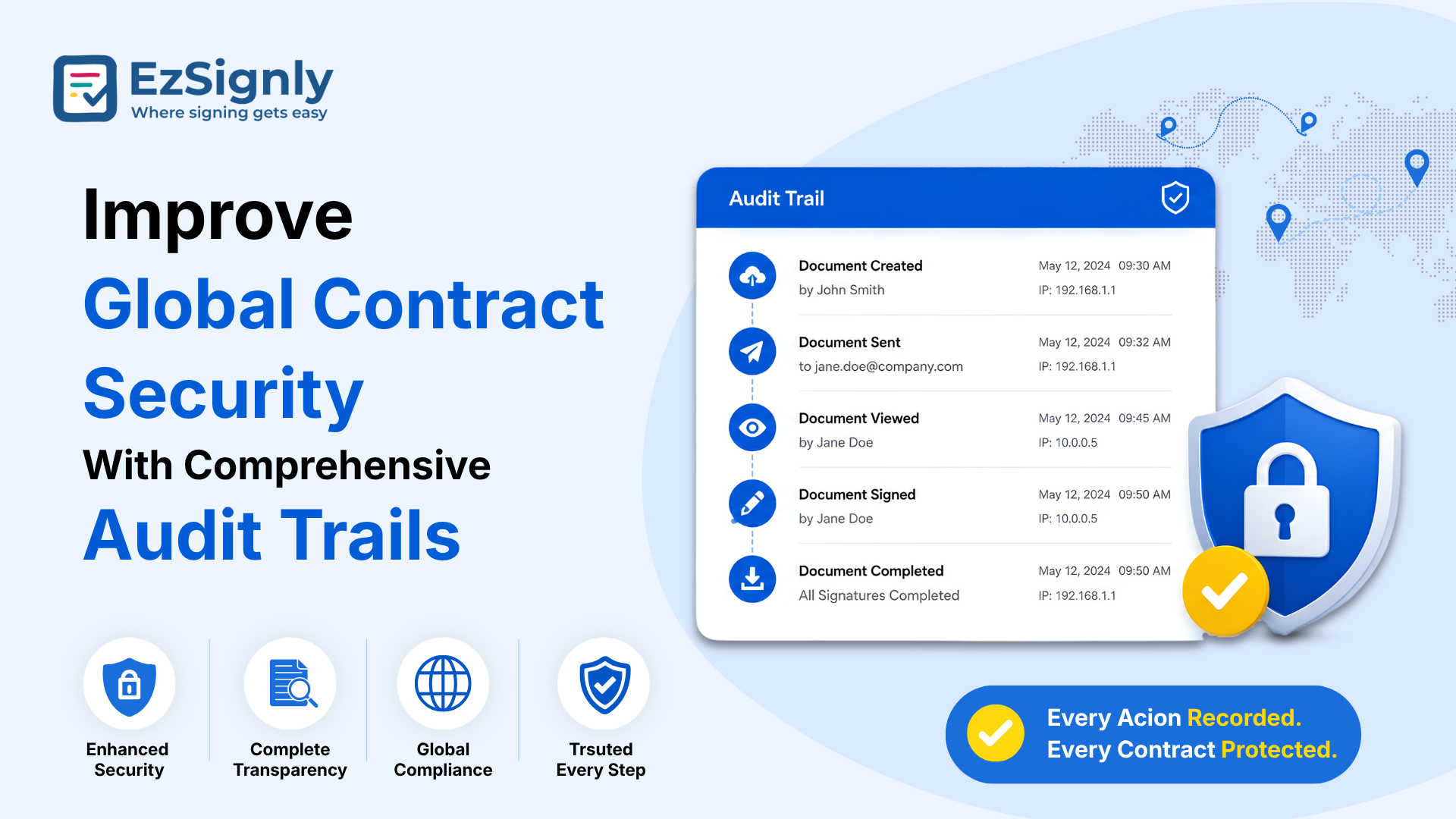
Improve Global Contract Security With Comprehensive Audit Trails
Imagine a contract dispute occurring six months after an international agreement was completed. One party claims they never signed it. Another argues that the document was changed after approval. A third person wants to know exactly when the agreement was accepted. A signed PDF by itself may not provide enough context. An audit trail creates a chronological record of the signing process. It can capture information such as when the document was sent, when it was opened, when actions were taken, and when the signing process was completed.
Best eSignature Software
For deals between people or companies in different countries, this extra evidence matters even more — because each side may follow different laws and business customs.
Platforms designed for business signing workflows can centralize these records. EzSignly, for instance, offers options such as audit trails, live tracking, identification verification, and secure document storage. This is not just an attempt to tick some boxes in the paper trail for the sake of compliance, but rather a feature that builds a transparent and concrete record of what actually occurred.
Data Privacy Matters When Documents Cross Borders
Legal validity isn't the only consideration when a document moves between countries. International agreements often include sensitive information — like employee records, financial data, customer details, intellectual property, or confidential business info. Accordingly, businesses will also need to consider issues such as individuals' right to privacy and information security..
Across countries and even across states within a country, data processing, transfer and accessibility and use might be governed by varying laws. United Nations Commission on International Trade Law's 2022 model on Identity Management and Trust Services specifically recognizes the importance of cross-border trust in online identification while noting that other laws, including data privacy and protection laws, continue to apply.
For U.S. companies, this means compliance teams should look beyond the signature itself. Similarly, companies looking for broader workflows can explore eSignature for businesses in US to manage digital signing across departments.
Power Global Operations With Simple Digital Workflows
However, managing international compliance doesn't necessarily have to make every contract into a legal nightmare. Instead, you can establish a lightweight workflow your team can easily replicate every time by creating approval workflows that vary based on the type of document, region, deal's risk factors, or individual signees involved.
Say, for example, an HR team onboarding an international employee could implement a workflow that ensures all IDs are verified, essential employment forms are collected, permits a digital signature, sends automated reminders, and maintains a thorough audit trail of all actions taken during the process.
For HR teams working across the United States, using eSignature Software for HR in US can make it much easier to manage everyday paperwork. These may be employment contracts, NDAs, offer letters, onboarding documents, and other compliance documents.
An HR solution rooted in the United States, such as this one, would be equipped with features such as pre-built templates, mass emailing, status checks, email prompts, and an audit trail detailing every document's history. The biggest benefit is consistency. When employees follow a clear, defined process, they're less likely to miss an important step — whether it's a signature, a verification, or a piece of required documentation.
Grow Across Borders With the Right eSignature Platform
A signing platform that's good enough for a 5-person company may not be good enough once that company starts working with international customers, vendors, contractors, and employees. As the business grows, it should look for a platform that offers features like:
| Requirement | Why It Matters for Global Transactions | |
| Identity Authentication | Helps establish signer identity | |
| Audit Trails | Creates evidence of the signing process | |
| Document Security | Helps protect sensitive agreements | |
| Templates | Standardizes recurring contracts | |
| Automated reminders | Reduces delays across time zones | |
| Sequential signing | Role-based access | |
| Sequential signing | Supports multi-party approval workflows | |
| Multi-device access | Makes signing easier for distributed teams | |
| Scalable plans | Supports growth without replacing the platform |
EzSignly's current plans include options ranging from a free tier to Standard, Business, and Business Pro offerings, with capabilities such as templates, audit trails, identity authentication, bulk sending, sequential signing, and role-based access depending on the plan.
So when you're comparing eSignature pricing and plans, don't be fooled by that seemingly modest month-to-month fee. Make sure you assess how many contracts your business actually needs to send every month and how many members of your team require access, as the answers to both questions influence your overall cost. You may also need some extra security features, like identity verification, digital signatures that require several approvals, and even more if you plan on dealing with various legal requirements as your business evolves.
Avoid Legal Risks From International eSignature Compliance Errors
eSignature pricing and plans can create confusion if businesses overlook small details, even when their digital workflow is already well set up. One common mistake is assuming that every electronic signature has identical legal status. Another is failing to preserve sufficient evidence of signer intent or identity.
Businesses may also overlook document-specific restrictions. Other contracts, industries, or geographies may impose their own distinct obligations, so additional legal scrutiny by a lawyer might be necessary in those cases. A second challenge is documentation inconsistencies: If one department dutifully records each step while another just stores a PDF version of the signed deal, the company has inconsistent proof across departments.
Your business should never think of compliance as an implement-and-forget process. Businesses evolve, technology evolves, regulations change, laws change, and customer partnerships change. All of these factors mean that the practices you might have followed to ensure compliance previously might no longer be valid. For that reason, it's important to audit and refresh your international signing workflows periodically.
Conclusion
Signing documents across countries is about more than just going digital instead of using pen and paper. It's about building a process people can trust — one that confirms who's signing, records their agreement, keeps the document safe, keeps proof of what happened, and follows the different laws and privacy rules of each country involved. For U.S. businesses growing internationally, the best approach is to pair good legal advice with a secure, flexible e-signing tool. With the right system in place, international deals can move faster — without losing control or confidence along the way. As business becomes more global, this kind of setup will only matter more. Your document-signing process should be ready for it.
Book a Demo and Go Global With Confidence.
Have any other questions? EzSignly's team is here to help!
FAQs
1. Are electronic signatures legally recognized across borders?
Electronic signatures are recognized in many jurisdictions, but the applicable rules can differ by country, transaction, and document type. International frameworks such as the UNCITRAL Model Law have helped establish principles for electronic transactions and signatures, but businesses should still evaluate the specific laws applicable to each transaction.
2. What makes a digital signature more trustworthy in an international contract?
Strong signer authentication, clear electronic consent, document integrity controls, detailed audit trails, reliable timestamps, and secure record retention can make a signing process more trustworthy. The appropriate controls depend on the risk and legal requirements of the transaction.
3. Should U.S. businesses get legal advice before using electronic signatures internationally?
For routine, low-risk agreements, a well-designed digital signing workflow may be sufficient. However, businesses handling regulated documents, high-value contracts, sensitive personal information, or jurisdictions with specific signing requirements should consider obtaining qualified legal advice before finalizing their international process.
Take a look at the latest blog
Say Goodbye to Manual Processes with Feature-Rich eSignatures - Start Free Trial
Automate document signing with feature-rich eSignatures. Save time and start your free trial today.
April 24, 2026
Why Automated eSignature Software Is a Smart Investment in 2026 – Start Your Free Trial Today
Save time, cut costs, and speed up approvals with automated eSignature software in 2026. Start your free trial today.
April 23, 2026
How HR Staffing Firms Use Electronic Signatures in 2026
HR staffing firms use electronic signatures to instantly sign contracts, offer letters, and compliance forms—reducing delays and speeding up hiring.
January 28, 2026
The Future of Rapid Document Approvals Using eSignature Software: Get 90 days Free Trail
Speed up document approvals with secure eSignature software and enjoy a 90-day free trial to simplify signing, reduce paperwork, and close deals faste...
July 14, 2026
Have any other questions? EzSignly's team is here to help!
© 2026 Copyright EzSignly. All Rights Reserved