


How US Law Firms Strengthen Contract Evidence With Compliant eSignatures: Get free Trial
November 20, 2026 | Posted By Admin
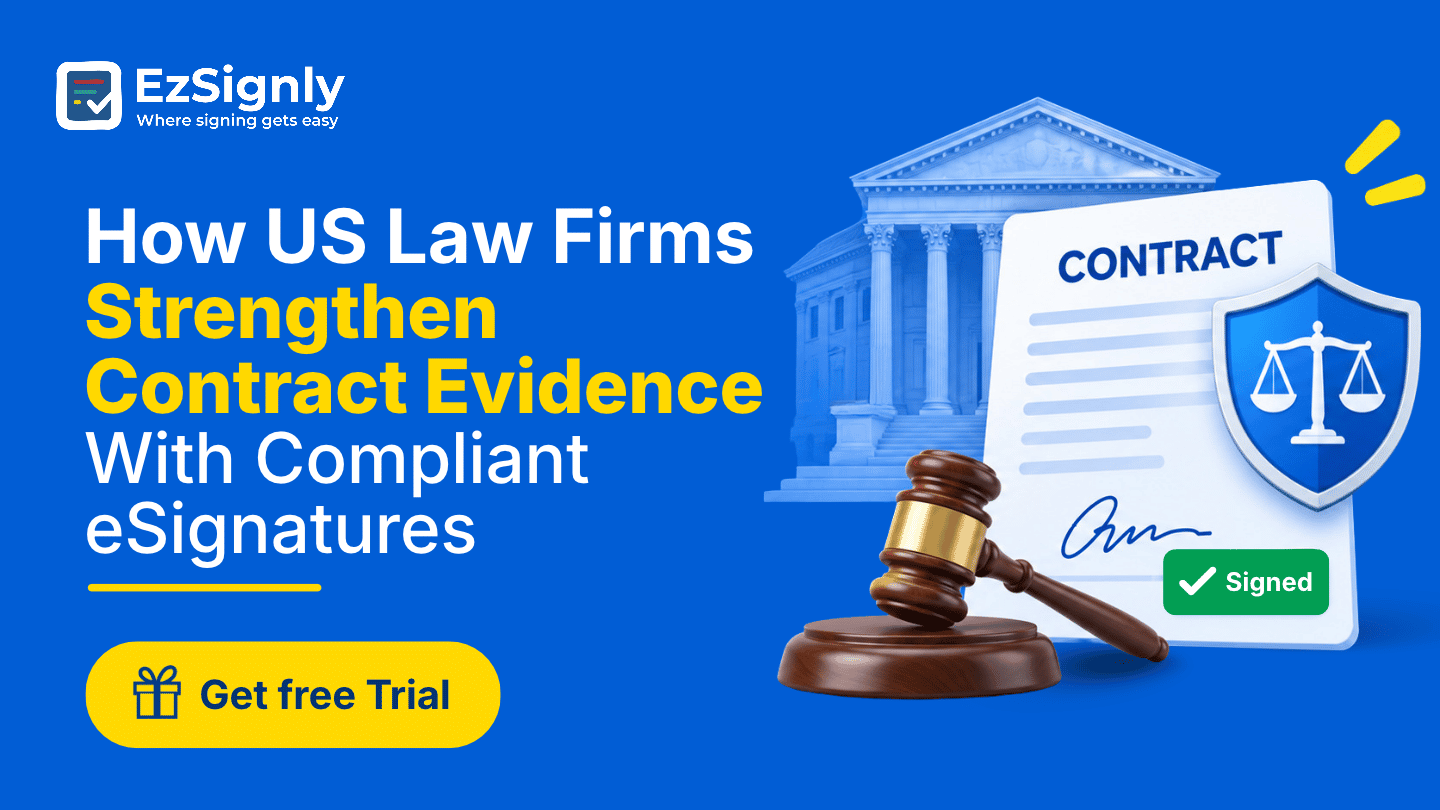
Electronic Signature for Legal Documents
Summary
Contracts are challenged in court all the time. When
this happens, there are usually four main questions: Who signed it? When was it
signed? Did they sign it on purpose? Is this the copy that was signed? EzSignly
has features that help answer all of these questions, and this blog will go
over how their features help with each of the four questions. The blog will
also cover the e-signing habits of the firm, the firm's hiring paperwork, plan
costs, e-signature limitations, and how small firms can test EzSignly's
features for free.
Introduction
When a contract is challenged and ends up in court, there are a few key questions that are often asked in a certain order. The first is, who signed it? Then, when was it signed? Next, did they sign it on purpose? Finally, is this the copy they signed? When firms select a legal eSignature solution in Chicago, they are really deciding how easily they can answer these questions months, or even years later.
This post will take you through each question and the records that help answer them. Then, we will go over habits that help keep evidence tidy and the firm's own practices. We will also go over costs for each plan and the eSign features page.
Question One: Who Signed It?
The starting point for each of the four questions is identity. The guide says that a trustworthy platform has a plan that verifies signer identity from the Standard plan and up. Also, two-step verification is an optional add-on from the Standard plan and up. Each user is invited to sign via an email unique to them, as well as a unique link. This gives a starting point for evidence of who acted.
Question Two: When?
Order matters when amendments or approvals happen in a particular order. The features page says that each action, from creation to viewing, signing, and completion, is recorded in a transparent audit trail with timestamps.
Having this sequence allows you to prove, for example, that an approval happened before a signature rather than after.
Question Three: Did They Mean To?
A signature has weight when it proves intent, and the process is secure and trackable. The record helps prove intent here as well. The record can prove a signer interacted with the document and completed each step intentionally.
Question Four: Is This the Same Copy?
A good eSignature Software for HR Operations in Chicago should protect the final copy from being altered. EzSignly describes its signing process as “tamper-proof” and says that the final copy should not be altered. The completed copy should be kept to prove integrity.
When pursuing a breach of contract claim against a
former employee, similar questions need to be answered. The Signing Flow will
define when the employee signed the contract. The Identity Checks will help
define if the employee signing the contract was the employee who was supposed
to sign the contract. The Timestamps help define whether the contract was
signed at the time it was supposed to be signed. Assuming all of the above are
the same, the contract will be deemed valid.
Habits That Build Better Evidence
Once the wording is acceptable to you, the document can be sent. The trust of the team is important, and the things done to the document after it has been sent may be the things that slowly erode that trust. Be open about it, and provide a new, corrected version. The record should always show both. Paperwork will always be more helpful than a single "corrected" document.
You should have standardised templates for commonly used documents. The Legal page provides templates for engagement letters, legal notices and licence agreements, to name a few. Paid plans provide unlimited templates. Approved text is spent reviewing and defining differences for each engagement letter as opposed to spending time on the matter.
Each signed document should be retained with the
signed original. You should download a copy and archive it rather than delete
it when a file is removed from your active list.
Who Can Touch What
Role-based access on the business plan lets you
control who can view, send or sign documents, so confidential documents remain
so. Standard plans limit this to three members, and business plans limit this
to five. The Multi-Account Hub for Firms helps switch accounts without logging
out, and provides unified audit trails.
Evidence Without an Enterprise Budget
Better records shouldn’t mean bigger invoices. Firms
trying to reduce eSignature cost in Chicago should take a close look at
the plans. One detail matters for legal work: the Free plan is a decent demo,
but the comparison table doesn’t show audit trails or identity authentication
for that plan. So evidence-related matters should be on a higher plan. Consider
how many people actually send documents, think about annual billing, and select
the plan that incorporates the records you rely on.
Limits Worth Remembering
Not all documents can be signed electronically. Wills and some court documents, as well as any needing a notary public, follow their own rules, and a court or agency decides what they will accept. The page shows many different kinds of legal documents, but listing a type of document doesn’t negate the requirements of the body or court that will accept it, so you should still check with them first.
An audit trail is good evidence, but it’s not the
verdict. A platform can’t replace an attorney's experience on the matter of
evidence. Make the record your best witness and let your attorney determine the
best way to present it.
Smaller Practices and Their Clients
Ease of use is key to solving a problem if you’re a solo practitioner or small firm. All of this can be learned fast and can be done by uploading, adding recipients, typing fields, and sending. Free pricing allows for full end-to-end automation to test if a paid plan is warranted. The platform’s API access allows firms to integrate signing processes with other services.
The system has benefits for clients as well. A solo practitioner can send a reminder to a small business client to finish and sign an engagement letter. The service allows the practitioner to know in real time who has signed and who has not.
Both smaller practices and their clients usually benefit most. Finding the best eSign service for small business in Chicago means locating an economical, quick-to-learn and adopt service that’s reliable when needed most. Similar requirements are true for smaller legal practices.
New sign-ups receive three free months as a welcome
offer. During that time, you can send real engagement letters and NDAs. You can
also see how the records are kept. If the case records are kept in a way that
supports your case in an ethics complaint or malpractice case, then you know
the service is useful.
Conclusion
Your contract is formed one signature at a time. Long before anyone tries to challenge your contract, you need evidence to answer the four questions. Timestamps answer when. A clear record of intent answers what. A protected final copy answers where. For identity, answer who. If you find yourself comparing, evaluate how each handles the four questions using a real-world example.
You should test the evidence question before you need
the answer. Open your free account at EzSignly and see for yourself.
Have any other questions? EzSignly's team is here to help!
FAQs
1. Can an audit trail help prove who signed a contract?
A: Yes. Each action on EzSignly is time-stamped and in Standard and above plans, the identity of the signer is authenticated.
2. Which plan should a law firm choose?
A: A paid plan should be chosen. Standard and above provide audit trails and identity authentication, and the Free plan does not.
3. Can eSignatures be used on all legal documents?
A: Not all legal documents are covered by eSignature laws. Certain court documents may have their own rules.
Take a look at the latest blog
Electronic Signatures Transform Business: Tips, Software, and Key Takeaways
Electronic signatures help businesses sign documents faster, securely, and without paper—streamlining workflows and improving efficiency.
March 9, 2026
eSignature Software Trends Every Business Sector Is Using with EzSignly in 2026
In 2026, businesses across industries use EzSignly to enable secure, AI-powered, and fully paperless digital document signing with seamless system int...
February 11, 2026
The Future Outlook for Electronic Signatures in Illinois Legal Documents | Book a Demo
Examine the prospects for electronic signatures in Illinois court papers. Find out about secure e-signing solutions, compliance, and trends. Schedule ...
July 28, 2026

What Makes Bulk Send Documents for eSignatures Leads to Business Growth: Signup Now
Send papers in bulk for eSignatures to expedite approvals, save time, and expand your company. Register right now.
July 20, 2026
Have any other questions? EzSignly's team is here to help!
© 2026 Copyright EzSignly. All Rights Reserved