


Is eSignature Legal and Secure? What Businesses Must Know
April 7, 2026 | Posted By Admin
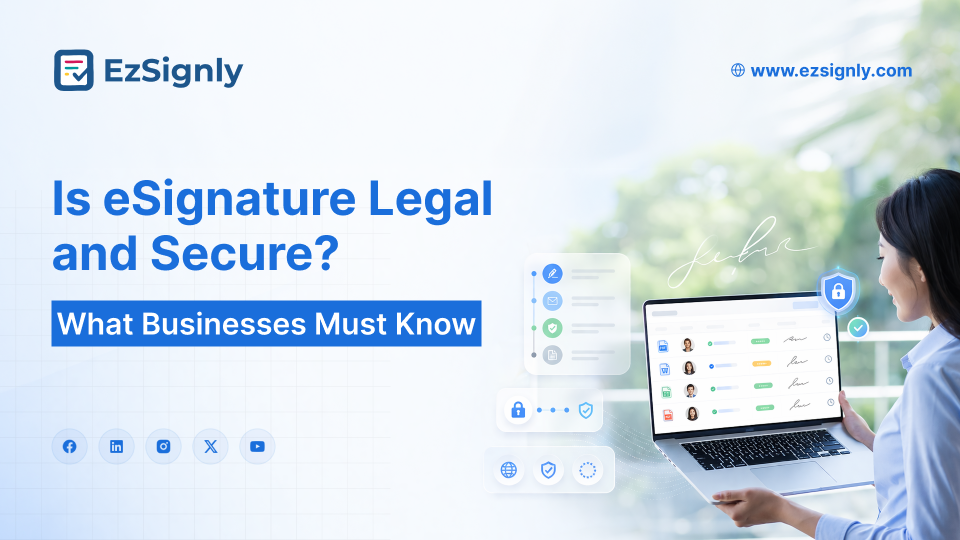
Secure Document Signing
Summary
EzSignly delivers E-SIGN Act and UETA-compliant electronic signatures with 256-bit AES encryption, tamper-evident audit trails, AI-powered field detection, multi-account login for law firms and corporate teams, court-admissible completion certificates, sequential signing workflows, and SOC 2 Type II security starting at $9 per user monthly, giving legal departments and businesses the compliance infrastructure that removes every objection to going paperless.
A general counsel at a regional healthcare group rejected an eSignature for legal rollout last quarter over a single question: what happens when a signer disputes that they signed? The vendor talked about encryption. The general counsel asked about the importance of the evidence.
The vendor mentioned cloud security. The GC asked whether the audit trail would survive a challenge. The call ended. The organization went back to printing and overnighting 600 contracts a month at $74,000 annually because the platform could not prove its signatures would hold up in a courtroom.
That hesitation is rational. A failed signature does
not just slow a deal, it unwinds it, exposes the organization to liability, and
puts the attorney's judgment on record. Understanding E-Signature Law is
not optional for teams. It is the threshold question that determines whether
digital signing is a tool or a liability.
The Framework That Makes eSignatures Enforceable
The enforceability question has a settled answer that many departments still treat as open. The E-SIGN Act of 2000 states directly that a signature or contract may not be denied legal effect solely because it is in electronic form. UETA, adopted by 49 states and DC, reinforces this at the state level.
Courts have affirmed this consistently. The standard for a legally binding and secure electronic signature rests on four evidentiary pillars. Intent to sign requires an affirmative action - a click, tap, or drawn signature. Consent to transact electronically requires disclosure before signing begins. Document integrity demands proof that the record has not been altered after execution. And the audit trail must capture who signed, when, from where, and through what authentication.
Platforms built for electronic signature For document
workflows embed all four pillars into the signing architecture automatically. Electronic
signature software for legal departments
that requires manual compliance setup introduces the same human-error risk
paper processes carry.
Why Legal Teams Are Embracing Electronic Signatures
The three most common objections, enforceability uncertainty, security concerns, and evidentiary gaps, have each been addressed by statute, case law, and platform engineering.
The enforceability of electronic signatures is firmly established by the ESIGN Act and UETA. Judicial precedent has uniformly upheld the legitimacy of contracts executed electronically across diverse scenarios, encompassing employment disputes, real estate contract signing, and commercial litigation. Furthermore, the implementation of e-signature platforms, which incorporate audit trails and comprehensive compliance mechanisms, proactively mitigates enforceability issues, frequently obviating the necessity for judicial involvement.
Security objections often crumble when examined closely.
Modern platforms operate with 256-bit AES encryption at rest, TLS 1.3 in transit, multi-factor authentication, and SOC 2 Type II certified infrastructure. A wet-ink signature on a FedEx truck has zero encryption, zero access control, and zero tamper evidence.
Evidentiary gaps close when platforms generate
court-admissible audit trails automatically. Every action- document viewed,
consent given, signature applied- carries a timestamp, IP address, and
authentication method. When departments assess the compliance of online
signature standards, the audit trail format is the most important specification
to consider.
AI Features That Remove Manual Work From Signing
Upload a 30-page commercial lease. The AI engine reads the structure, identifies signature blocks, witness lines, date fields, and notarization placeholders, and places every field automatically. A document taking a professional 12 minutes to set up manually ships in under 60 seconds. Across 400 monthly documents, which recovers 60 to 80 hours monthly.
AI field detection also eliminates the most common signing failure: missed fields. A single unsigned initial line on page 14 sends the entire document back, adding two to four days. Smart classification automatically identifies the document type—be it an NDA, a services agreement, or a closing package—and then applies the appropriate settings, all without needing any manual intervention.
The multi-account login simplifies things for attorneys and their support staff, allowing them to handle various client projects from a single, user-friendly dashboard.
Think about a litigation partner handling three
corporate clients, or a real estate associate coordinating seven closings; both
can immediately see their individual tasks, eliminating the need to constantly
switch accounts. Furthermore, this setup helps firms comply with the ethical
wall requirements imposed by bar associations, which are designed to prevent
conflicts of interest.
What Makes Electronic Signatures Secure?
Documents are secured at rest using 256-bit AES encryption, and while they're being transmitted, we use TLS 1.3. To confirm a signer's identity, we verify it through email, SMS codes, or questions designed to test knowledge before a signature is applied. A cryptographic hash is used to verify that any alteration, even a single character, after signing will break the hash, making tampering immediately apparent.
Finally, role-based access controls are in place to
limit document visibility. Platforms that excel in e-signatures for law
department often provide tamper-evident completion certificates. These
certificates are included with the signed document, remaining with it
indefinitely. This means you don't need the vendor's software to verify the
signature years down the line. This self-contained evidence package is what
distinguishes enterprise-grade platforms from consumer-focused apps, which
typically store proof on servers that might not be accessible when a dispute
arises.
How Legal Departments Use eSignatures Across Practice Areas
Litigation teams find electronic signatures useful for settlement agreements, engagement letters, and expert retention agreements. By employing e-signature software tools equipped with audit trails and compliance controls, firms can manage discovery requests more efficiently. They can simply export completion certificates, avoiding the need to recreate cumbersome paper trails.
Transactional attorneys see deals wrapped up more quickly when signatures are completed in minutes, not days. E-signing real estate contracts cuts down on closing times by removing the need for couriers, which typically adds three to five business days. A commercial closing involving four parties can be finished in one remote session.
The top eSignature solutions for real estate professionals feature sequential workflows, directing documents through the buyer, seller, broker, and attorney in the correct order.
Employment professionals use the same platform to
manage separation agreements and noncompete acknowledgments. The platform's
audit trail provides proof that the departing employee received something of
value, had time to review the agreement, and signed it voluntarily.
What eSignature Platforms Cost for Law Departments
A department with 10 users processing 500 documents monthly should evaluate total cost, not sticker price. Enterprise platforms at $40 per user run $4,800 annually before overages and add-ons. Digital Signature Pricing starts at $9 per user monthly. Ten users cost $1,080 annually with unlimited documents, audit trails, sequential signing, and templates, a gap of $3,720 per year for the same compliance outcome.
An eSign plan for both personal and business
use grows without the need for complex enterprise agreements. Whether you're a
solo practitioner dispatching thirty documents a month or a fifty-attorney firm
sending out two thousand, the per-user rate remains the same. There are no
penalties for volume, no charges per envelope, and no restrictions on
compliance features.
Have any other questions? EzSignly's team is here to help!
Benefits of eSignatures for Law Departments and Businesses
Teams that ditch traditional signatures in favor of compliant electronic workflows often see immediate gains. Within the first month, they typically experience improvements in compliance, speed, cost, and client satisfaction.
- Signing turnaround drops from days to under 20 minutes, removing the bottleneck that delays closings and engagements
- Every signed document carries a court-admissible audit trail with timestamps, IP addresses, authentication method, and tamper-evident hash verification
- Document preparation time falls 90 percent when AI field detection replaces manual setup across hundreds of monthly documents
- Multi-account login lets attorneys manage multiple client matters from one dashboard while maintaining ethical wall separation
- ESIGN Act and UETA compliance is embedded in every signing event automatically, not dependent on user configuration
- 256-bit AES encryption, TLS 1.3 security, and multi-factor authentication exceed the protection level of any paper-based process
- Sequential and parallel signing routes multi-party agreements through the correct execution order without manual tracking
- Template
libraries store engagement letters, NDAs, settlement agreements, and
closing documents for one-click reuse
Conclusion
The ESIGN Act, UETA, and decades of case law confirm electronic signatures carry the same enforceability as wet ink when the platform produces the evidence courts require. The security question is answered. Encryption, authentication, and tamper-evident audit trails exceed paper-based protections by every measurable standard. EzSignly’s online signature platform for legal teams gives you AI-powered document preparation, court-admissible audit trails, multi-account login, sequential signing, 256-bit encryption, and ESIGN Act compliance starting at $9 per user monthly. Every week spent printing and couriering contracts is a week of cost and compliance exposure that disappears the moment the platform handles it.
→ Get started with secure and legally
binding signatures for free!
FAQ
1. Are electronic signatures legally binding in the United States?
Indeed. The ESIGN Act of 2000 and UETA establish the foundation at both the federal and state levels. A contract's enforceability can't be dismissed simply because the signature is electronic.
2. What makes an electronic signature secure enough for legal documents
Platforms utilize 256-bit AES encryption for data at rest, alongside TLS 1.3 for data in transit, multi-factor authentication, and tamper-evident audit trails. Furthermore, cryptographic hash verification identifies any modifications post-signing, thereby surpassing the security measures of traditional paper-based systems and meeting the requirements of SOC 2 Type II compliance.
3. What should legal departments look for in an eSignature platform?
At a minimum, the software should provide court-admissible audit trails, the ability to sign documents in a specific order with multiple parties, a library of templates, role-based access controls, and self-contained completion certificates. It's also important to steer clear of platforms that restrict audit exports or advanced authentication features to higher-priced tiers.
4. How much do eSignature platforms cost for legal teams?
Digital signature services, built on secure platforms, start at just $9 per user per month. For a department of ten, the yearly total comes to $1,080, a substantial reduction from the $4,800 or more that enterprise-level platforms frequently demand.
Take a look at the latest blog
Legal eSignature Software Tool for Real Estate: Are eSignatures Legal in Illinois?
eSignatures are legal in Illinois and have the same validity as handwritten signatures when both parties consent and proper electronic records are mai...
March 11, 2026
Mobile eSignatures: How EzSignly Helps You to Sign Documents Anytime, Anywhere
EzSignly lets you sign documents anytime, anywhere from your mobile device quickly and securely.
March 6, 2026
A Comprehensive Guide: To Sign Your Documents with E-Signatures Tool
In this guide, we will talk about the world of Free eSignature software, illustrating how you can us them to enhance your productivity and protect you...
January 13, 2026
How Businesses Save Thousands Every Year Using eSignature Software in USA
US businesses save thousands using eSignature software by cutting paper costs and speeding up approvals.
March 25, 2026
Have any other questions? EzSignly's team is here to help!
© 2026 Copyright EzSignly. All Rights Reserved