


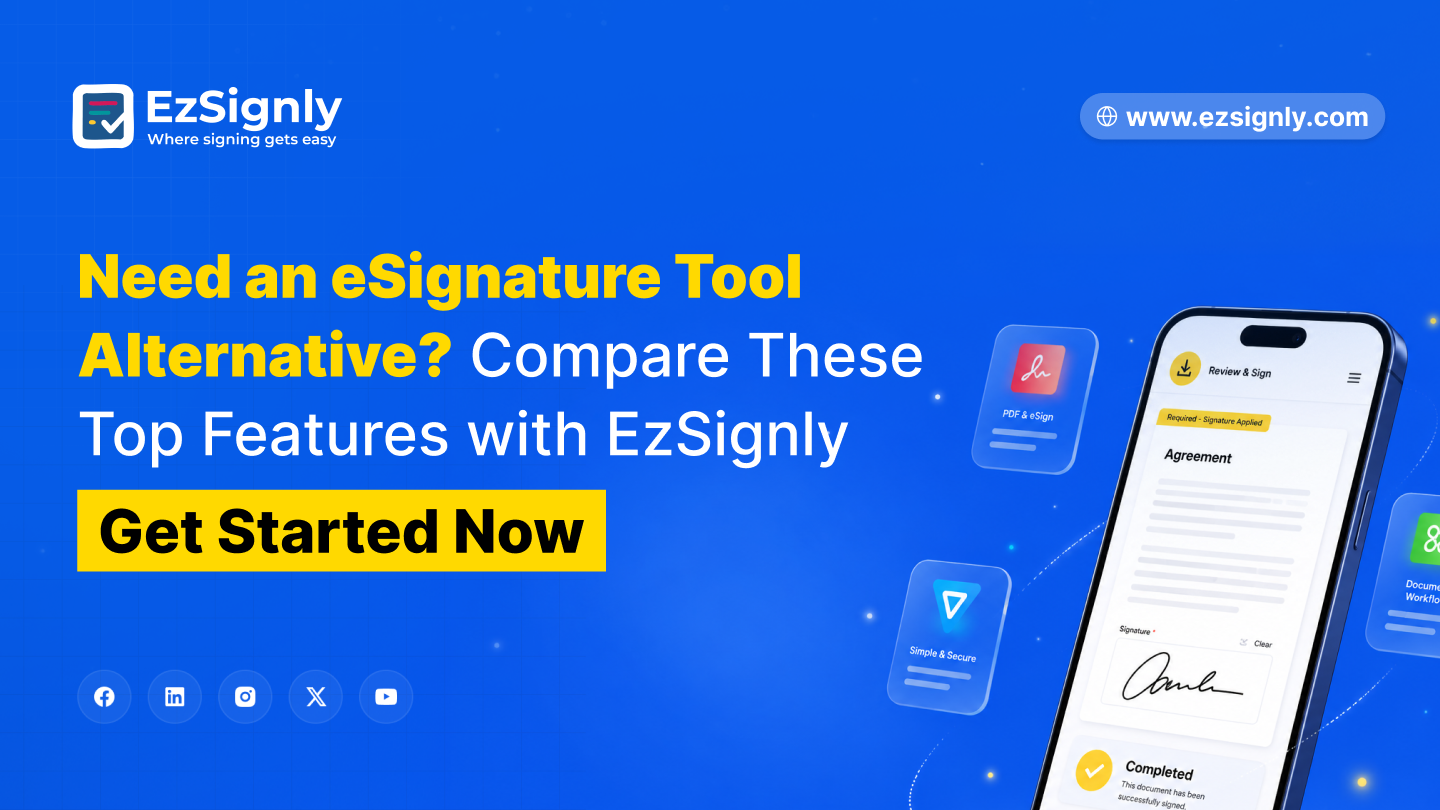
Need an e-signature tool alternative? Compare These Top Features with EzSignly
April 30, 2026 | Posted By Admin
Best eSignature Software
Summary
Looking for a better e-signature tool means focusing on what truly impacts performance—security, scalability, and workflow efficiency. Modern platforms are no longer just about signing documents; they offer audit trails, automated reminders, integrations, and compliance-ready features that directly influence business outcomes.
When comparing alternatives, prioritise tools that
combine ease of use with robust transaction management and seamless
integrations. This is where solutions like EzSignly stand out—bringing together
essential features without the complexity or high costs often associated with
legacy platforms.
Introduction
Businesses in the United States have significantly
increased their demand for a reliable electronic signature for online
documents as they reassess whether legacy platforms justify their cost and
complexity. In 2026, the focus has clearly shifted to solutions that prioritise
simplicity, affordability, and scalability over brand recognition. The U.S.
eSignature market continues to expand rapidly, driven by stricter compliance
needs and fully digital workflows, while newer platforms now offer comparable
legal validity and security at more competitive pricing. As organisations
evaluate alternatives, the decision is less about popularity and more about
operational efficiency and long-term value. A structured comparison of key
features highlights how modern solutions like EzSignly align with these
evolving business requirements.
Why Businesses Are Moving Beyond Traditional eSignature Tools
For many U.S. companies drive the decision to switch due to cost inefficiencies and unnecessary complexity. Enterprise tools often include advanced modules that smaller teams do not fully utilise, yet still pay for.
A recurring concern is pricing models based on per-user or per-envelope billing, which can increase costs as businesses grow. Additionally, onboarding complexities and layered interfaces can slow adoption across teams.
Modern alternatives address these issues by focusing on usability, automation, and predictable pricing—key factors for scaling operations efficiently.
Core Feature #1: Legal Compliance Across the United States
Any viable alternative must comply with the ESIGN Act and UETA, which establish the legal validity of electronic signatures across all 50 states. Without this compliance, digital agreements may not hold up in legal or commercial contexts.
EzSignly aligns with these frameworks, ensuring that every signed document maintains enforceability. This is particularly relevant for industries such as HR, finance, and real estate, where compliance is non-negotiable.
Core Feature #2: Security and Audit Trails That Hold Up
Security remains a central evaluation criterion. Leading platforms now offer encryption standards, identity verification, and detailed audit logs that capture timestamps, IP addresses, and signer activity. EzSignly incorporates secure authentication and comprehensive audit tracking, ensuring that every transaction is verifiable and tamper-resistant – critical for high-value agreements.
Core Feature #3: Ease of Use and Rapid Adoption
One of the most significant differentiators among modern eSignature tools is usability. Businesses no longer want platforms that require extensive training or administrative configuration.
Many newer solutions prioritise:
- One-click signing
- Drag-and-drop document preparation
- Mobile-first interfaces
This platform reflects this shift with a streamlined interface designed for immediate use, allowing teams to transition without operational disruption.
Core Feature #4: Workflow Automation and Time Savings
Automation is where modern platforms outperform traditional tools. Features such as automated reminders, bulk sending, and template creation significantly reduce manual workload.
Instead of chasing signatures or managing email threads, businesses can create structured workflows that move documents through approval stages automatically. This is especially valuable for HR onboarding and contract-heavy industries.
For organisations managing employee documentation, solutions like eSignature Software for HR in the USA highlight how automation reduces administrative overhead while maintaining compliance.
Core Feature #5: Integration with Business Ecosystems
An effective e-signature tool must integrate seamlessly with existing systems such as CRM platforms, cloud storage, and document management tools.
Established providers like DocuSign offer extensive integration ecosystems, with hundreds of supported applications. However, such integration often comes with added complexity and cost.
Our software tool focuses on practical integrations that align with everyday business workflows, ensuring that document signing becomes a natural extension of existing processes rather than a separate system.
Core Feature #6: Cost Efficiency Without Compromise
Cost is a decisive factor for most businesses evaluating alternatives. Traditional platforms are often perceived as premium solutions, with pricing structures that scale aggressively as usage increases.
In contrast, newer tools are designed to deliver similar functionality at significantly lower price points. Some alternatives offer up to 80% cost savings compared to legacy platforms while maintaining compliance and security standards.
For organisations comparing e-signature pricing and plans, the focus should be on long-term scalability rather than short-term affordability.
Core Feature #7: Industry-Specific Use Cases
Different industries require tailored capabilities. For instance, real estate transactions demand secure, high-volume signing with multiple stakeholders involved.
Solutions that support secure real estate e-signing online ensure faster deal closures, improved transparency, and better coordination between parties.
This tool adapts well to such use cases, offering
flexibility for industries that rely heavily on documentation workflows.
Feature Comparison Snapshot
Choosing an eSignature platform is ultimately about how well its features align with day-to-day business requirements rather than surface-level functionality. A clear, side-by-side understanding of capabilities helps organisations identify gaps, inefficiencies, and value drivers before committing to a solution.
Below is a concise comparison snapshot to simplify evaluation and decision-making.
| Feature | Traditional Platforms | Modern Alternatives (including EzSignly) |
| Pricing Model | Per-user/per-envelop | Flexible, affordable |
| Ease of Use | Complex Setup | Minimal Learning Curve |
| Compliance | ESIGN, UETA-compliant | Same compliance standards |
| Automation | Advanced but complex | Simplified Automation |
| Integrations | Extensive but heavy | Practical and Streamlined |
| Scalability | Expensive at Scale | Designed for growth |
What Sets EzSignly Apart in 2026
While many alternatives focus on cost reduction, fewer manage to balance affordability with functionality. Our platform differentiates itself by combining:
- AI-powered document handling
- Bulk sending and smart field detection
- Mobile-first design
- Rapid deployment without technical overhead
It is particularly suited for small to mid-sized businesses that require enterprise-grade reliability without enterprise-level complexity.
Choosing an eSignature tool in 2026 is less about brand recognition and more about operational alignment. The right platform should:
- Fit seamlessly into your workflows
- Scale with your business growth
- Provide transparent and predictable pricing
- Deliver a user experience that encourages adoption
The shift towards leaner, more efficient platforms
reflects a broader trend in SaaS—tools must justify their cost through actual
usage, not perceived value.
Conclusion
The demand for alternatives to traditional eSignature tools is not a passing trend—it reflects a fundamental shift in how businesses approach digital workflows. As the market matures, organisations are moving toward solutions that prioritise usability, cost efficiency, and scalability.
We represent this new generation of tools, offering a balanced approach that meets the practical needs of modern businesses in the United States. For companies seeking a smarter way to manage digital agreements, the focus should not be on replacing a tool but on upgrading the entire signing experience.
FAQs
1. What is the best alternative to traditional eSignature tools in the USA?
The best alternative depends on your business needs. Many companies are moving towards cost-effective platforms like EzSignly, which offer similar features with simpler workflows and lower pricing.
2. Are electronic signatures legally valid in the United States?
Yes, electronic signatures are legally valid under the ESIGN Act and UETA, provided they meet authentication and consent requirements.
3. How do I choose the right eSignature tool for my business?
Focus on key factors such as compliance, security, ease of use, integration capabilities, and pricing structure. A tool that aligns with your workflow and scales with your business is the most suitable choice.
Take a look at the latest blog
Secure eSignatures for Home Buyers: Eliminating document forgery in Real Estate- Try 3 Month Free Trail
Secure eSignatures for home buyers. Prevent document forgery and close deals with confidence. Try a 3-month free trial.
July 8, 2026
Boost Business Growth With Mobile eSignatures and Faster Deal Completion — Book Your Demo
Accelerate deals with secure mobile eSignatures. Sign anytime, anywhere, and boost business growth. Book your demo today.
June 24, 2026
End-to-End Workflow Automation with eSignature Integration: Get 3 Months Free Trail
Utilize a single platform to automate processes, streamline approvals, and gather secure eSignatures. For a little period, sign up now to receive thre...
August 3, 2026
Are eSignature Features the Answer to the Problems of Inaccessible Work? Book a Demo Today
Make work accessible for every team member with secure, easy-to-use eSignature features. Simplify approvals, reduce delays, and keep documents moving ...
May 18, 2026
Have any other questions? EzSignly's team is here to help!
© 2026 Copyright EzSignly. All Rights Reserved