


Pro & Cons of eSignature Software With Automation in HR Onboarding: Book A Demo
July 21, 2026 | Posted By Admin
Electronic Signature for HR Solution
Summary
The USA's HR departments are ditching their reams of
paper for electronic processes, and onboarding is the first to change. This
blog will go over the real-world pros and real-world cons of adding eSignature
technology to your recruiting process. By the end, you'll be able to answer
whether a digital workflow makes sense for your organization's budget, size,
and legal compliance needs.
Introduction
Step into any HR office today and you'll likely see
that things look a lot different than they did a couple of years back. File
cabinets are becoming more digital, paperwork is shrinking, and process
documents such as signing offer letters, tax forms, NDAs, and benefits and
enrollments can take minutes or hours rather than days. The driving force
behind this evolution in human resources is the adaptation of esignature
software for HR in USA businesses. What used to be a non-mandatory
add-on is now integral to the HR function. It helps to simplify workflows,
accelerate time to hire, and create a positive new hire experience. But like
any solution that handles employee data and any binding document, esignature
software is not a silver bullet. There are definite benefits to be excited
about, and clear pitfalls for any HR leader to consider before committing to a
vendor agreement. We examine both in this post.
What’s Actually Driving HR Teams to Adopt Automated Onboarding?
The pandemic gets a lot of credit for accelerating remote work tools, and it also swept onboarding software up in that wave. All of a sudden, companies that assumed new hires would come in to sign a folder full of paperwork needed to find a way for an employee from Ohio to join a team based in California without stepping foot inside a workplace.
Job seekers now have expectations around a seamless, mobile-friendly application and onboarding experience - so clumsy paper forms can make you look decidedly dated before your new hire has even started. Human resources teams figured that out too. Plus, in a process that seems as manual and as backward as the hiring process often is, you're going to end up with increased employee turnover. Your initial impression is so incredibly important, yet so many managers dismiss it.
So not only did automation digitize signatures, it
reimagined the entire employee pre-boarding process: everything from background
checks and benefits enrollment through to IT provisioning.
The Pros: Why HR Teams Are Genuinely Excited About This
Let's start with what's working, because there's plenty. Once a company moves onboarding paperwork into an automated eSignature workflow, the impact tends to show up almost immediately — in how fast a new hire gets set up, how clean the paperwork looks, and how little back-and-forth is needed to close out a file. The table below breaks down the biggest wins HR teams typically report after making the switch.
| Value | How HR Processes Are Changing |
| Speed | Paperwork that used to sit in an inbox for days now gets handled, signed, and filed within hours. Onboarding new employees includes getting their W-4s, direct deposit, and policy sign-offs before their morning latte. |
| Fewer Mistakes and Manual Follow-ups | Workflows help you avoid lost signatures on the 4th page or missing values before submission. Say goodbye to chase emails to retrieve this missing piece of information. |
| A better hiring journey | A well-done digital onboarding shows a company is well put together, and that's something a candidate shifting through competing job offers will pay attention to. |
| Centralized Audit Trails | You get an automatic log for all of your signatures, timestamps, and versions, all of which can be super useful when a compliance team or an auditor asks questions. |
| Grow Faster With Fewer Resources | The seasonal ramp-up can still bring the demands of a new employee a day (or two, or three!) without a proportional team expansion. |
This same automation logic has started spreading well
past HR departments. Industries built on high-volume paperwork are borrowing
the same playbook. eSignature software for real estate in US transactions,
for instance, has seen similar gains, with agents closing deals faster because
buyers and sellers no longer need to meet in person to finalize contracts. The
underlying technology is the same; only the document types change.
The Cons: Where Automated eSignature Tools Fall Short
None of this comes without friction, and it's worth being honest about it. Many frustrations with onboarding can be eliminated through automation, but the process can also lead to new problems that HR professionals may not anticipate for months after a platform's launch. Familiarity with those compromises will save you much pain later and help you make a much better selection of software and rollout strategy for your company.
- Upfront cost and vendor lock-in. Enterprise-grade eSignature platforms with HR-specific automation features aren't cheap, especially once you factor in integrations with existing HRIS or payroll systems. As smaller businesses, they can feel caught paying for higher tiers of features they will never utilize in order to have the one integration that they'll actually use.
- Not every state treats digital signatures identically. While the ESIGN Act generally allows for the legal validity of electronic signatures on a federal level, there are still types of documents (like certain real estate closings, wills, and some types of state employment contracts) that may have additional stipulations or exceptions. HR departments who conduct business in more than one state need to be certain they're paying attention to these differences and not just going off a single federal rule.
- Over-automation can lead to depersonalization. There will always be new hires - especially in smaller or more traditional companies - who prefer the human element in the onboarding process. Sending a full stream of documents without a personal follow-up can come off as depersonalizing, especially for high-level hires.
- Security concerns remain real. For that matter, anyone holding someone else's SSN, bank details, and signed contracts can be pretty sure it's a prime bait for those who aren't good guys. The team at HR must investigate each vendor regarding encryption levels, security access protocols, and past breaches, instead of just believing that all vendors are alike in the security department.
- Technical hiccups can disproportionately affect less tech-savvy hires. It goes without saying that technical problems tend to have a bigger impact on less digitally native employees. All candidates are not equally equipped to find their way around a digital signing portal - especially if you hire older people or have candidates who don't have much experience with technology. An invalid link and a confusing interface will hinder onboarding just as much as the paper version did.
Budget conversations often come up quickly once HR
leadership starts comparing platforms. You'll discover that pricing varies
greatly from one location to the next and one vendor to another, and local
resellers and consultants may sometimes tailor packages to you differently than
national providers. Companies looking for eSignature pricing and plans
in Chicago will likely see significant price variation, as local
onboarding support and ongoing training can add a higher degree of TCO than
sticker prices.
Compliance: The Piece HR Teams Can't Afford to Skip
Legal defensibility is where many HR departments get nervous, and rightly so. But an e-signature is only as secure as the audit trail behind it. If the ex-employee contests having signed an arbitration or non-compete agreement, you must show that they actually signed the document, that it was signed by the correct person, in real time, under no undue pressure, and that they understood exactly what they were signing.
This is why credible vendors have tamper-evident seals, keep IP address logs, and have multi-factor authentication in place. However, HR leaders should not simply assume that an employee is guaranteed to comply just because the vendor says the platform is "legally binding." Consider having your own legal team look over particular document templates before automating your entire HR department, especially when it comes to anything related to non-competes, severance packages, and arbitration agreements, as enforceability can vary depending on your location.
Companies handling more complex agreements sometimes
lean on specialized legal support to make sure their templates hold up. Firms
offering eSign document for legal in Chicago services have
become a resource for HR and legal teams working through exactly these kinds of
jurisdiction-specific questions before automation gets rolled out company-wide.
Balancing Automation With the Human Side of Onboarding
Most HR executives figure out the best path is not 'all or nothing' - it's both. Use automation for all the repetitive and form-focused elements of onboarding—tax forms, policy sign-offs, and benefit enrollments. Leave in the human bits - the onboarding call, manager introductions, and team culture walk-through—that no portal could possibly achieve.
And it also achieves the best results for retention.
Onboarding that gives new hires the "wow" experience they expect from
a company these days, while not feeling like just another checkbox, is ideal
for their first week.
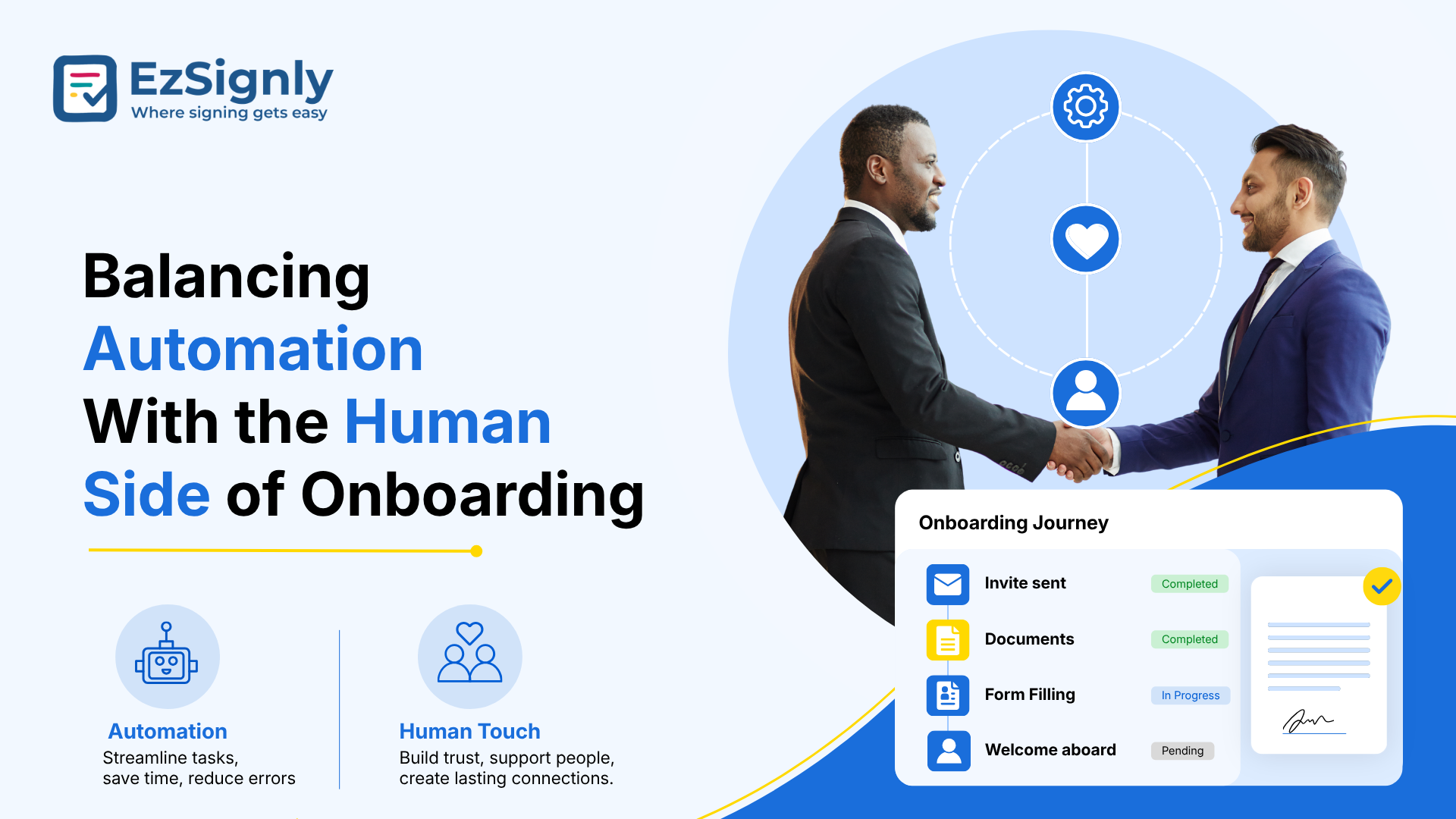
Best eSignature Solution
Choosing the Right Platform for Your HR Team
Not every eSignature platform is built with HR workflows in mind. Some are designed primarily for sales contracts or real estate closings and only loosely adapt to onboarding needs. But before jumping into an implementation project, HR teams need to figure out their real volume of documents, in how many states they're making offers, and how that data will integrate with payroll and other systems.
EzSignly advises that getting the assessment right at
the start prevents many problems later on. It's a pain to switch to another
vendor mid-year compared to taking an extra few weeks up front.
Conclusion
Esignature automation has truly revolutionized the way we conduct HR onboarding throughout the United States. By reducing the time it takes to process new hires and streamlining the overall candidate experience, it's far surpassed paper, but automation does come with a price tag. Compliance concerns and the inherent loss of personal connection aren't necessarily red flags, but they are key HR considerations. The companies deriving the greatest benefit use automation as a supplement to their employee experience rather than a substitute.
👉Work
Faster, Sign Smarter - Book a Demo Today!!!
Have any other questions? EzSignly's team is here to help!
FAQs
1. Is an electronic signature legally valid for employment documents in the USA?
A: Yes, in most cases. Under the federal ESIGN Act and the Uniform Electronic Transactions Act adopted by most states, electronic signatures carry the same legal weight as handwritten ones for the vast majority of HR documents, though a few document types have state-specific exceptions.
2. How long does it typically take to onboard a new hire using automated eSignature tools?
A: Many HR teams report cutting document turnaround from several days to just a few hours, though actual timing depends on the number of forms involved and how quickly the new hire responds to signing requests.
3. Can small businesses benefit from eSignature automation, or is it only useful for large enterprises?
A: Small businesses often see proportionally bigger benefits, since they typically lack dedicated HR staff to manually chase paperwork. Even a handful of automated workflows can free up meaningful time for a lean team
Take a look at the latest blog
How eSignature Empowers Small Businesses for Digital Document Signing
For small industries, growth is driven by innovation, customer demand, and the ability to move quickly. Yet, as businesses scale, everyday operations ...
January 22, 2026
Boost Your Small Business: The Growth Benefits of Going Paperless with eSignatures
eSignatures help small businesses go paperless, saving time, reducing costs, and speeding up document approvals.
March 18, 2026
Secure eSignature Tools to Reduce Real Estate Signing Delays – Get a 3-Month Trial
Speed up real estate deals with secure eSignature tools that reduce paperwork delays and simplify document approvals. Get a 3-month trial today.
June 10, 2026
How Businesses Are Closing Deals 80% Faster With Mobile eSignatures: Book Your Demo
Close deals up to 80% faster with secure mobile eSignatures. Sign anytime, anywhere. Book your demo today!
June 29, 2026
Have any other questions? EzSignly's team is here to help!
© 2026 Copyright EzSignly. All Rights Reserved