


The Evolution of Electronic Signatures and the Shift from Paper to Digital Trust
January 22, 2026 | Posted By Admin
Best eSignature Solution
As times changed, and business got less paper-centric and more tech-savvy, eSignatures became commonplace in the digital document world. EzSignly is holding your hand to help you in this transition by providing secure eSignatures, remote signing, audit trails and much more and at a fraction of the cost.
The transition to digital transformation has completely altered the process of creating, approving, and authenticating documents for businesses worldwide. Of all the digital transitions over the years, the emergence of eSigned documents is undoubtedly one of the most influential.
What once required paper documentation for approval has now transitioned to fast, authentic electronic transactions using Electronic Signature Software .
The Era of Paper-Driven Documents: Limitations That Slowed Business
For several decades, paper-based documents were the mainstay of all organizational operations. Documents such as contracts, agreements, approvals, and compliance documents were all printed, signed, scanned, couriered, and archived. Although this was effective in the past, this process is fraught with its own shortcomings.
The paper-based process was slow, expensive, and error-prone. Papers could go missing, people’s signatures could be forged, and approval could take time because it depended on the location of the person granting it. Storing or retrieving documents also added an operational burden, not to mention the risks involved in the audit process when ensuring compliance.
In a rapidly changing global economy, paper did not keep pace. Inefficiencies could be viewed as security risks, non-scalability, and non-accessibility, which led to the emergence of eSign for Digital documents.
The Birth of Electronic Signatures: From Cryptography to Usability
In the initial phase, the Electronic signature evolved from cryptographic techniques used to secure the identity of documents to verify the identity of the person placing the signature. The concept of digital signatures was to make extensive use of encryption techniques and key management systems.
Despite its high level of security, this is not an inexpensive solution suitable for non-technicians.
Adoption remained modest until the emphasis swung from security to usability.
Today, there is electronic signature software that simplifies the process of signing documents, allowing users to sign documents by clicking, tapping, or typing–all while being secure. It is this combination of ease of use, security, and trust that has made the current e-signature ecosystem what it is.
Early Challenges and Legal Recognition of eSignatures
Why Regulation Became Essential
As eSignatures became increasingly common, concerns about their validity began to surface. Organizations using them and dealing with them began to wonder if these electronically signed documents could be considered valid in court.
Landmark Legal Frameworks That Changed Everything
However, all of that was to change when the United States passed the Electronic Signatures in Global and National Commerce (ESIGN) Act in 2000, which legalised the use of electronic signatures for all legal transactions provided consent can be established.
And this marked the beginning of a legal milestone that enabled companies to feel confident replacing physical signatures in document business processes with ‘eSign.’ This further led to other countries adopting this legislation, assuring ‘eSignatures’ to be not just a functionality but something trustworthy.
Global Acceptance and Standardisation of eSignatures
The growing global digital commerce market made standardisation a necessity.
Governments and international organizations began recognizing the validity of electronic signature software as authorization tools, especially for international business transactions.
eIDAS Regulation in the European Union
The European Union introduced the eIDAS Regulation, which standardised the use of electronic identification and trust services across all member states. This led to different levels of electronic signatures, all recognized on a universal level, the key to business adoption.
Interoperability and Compliance
There were standardized formats and compatibility between systems that made sure that any document signed electronically in a given system could be verified and validated in other systems as well. This made the world a more trusted place and facilitated rapid adoption in other countries as well.
Technological Advancements That Drove Mass Adoption
Technological advancements were a critical factor in popularising eSignatures. Today, advanced software solutions for eSignatures eliminated technological sophistication with user-friendly interfaces such as drag-and-drop fields, click-to-sign actions, and cloud convenience.
Cloud technology further enabled accessibility and allowed secure document signing from anywhere in the world. Such developments ensured there was no dependence on location and reduced turnaround times.
Integration with Business Workflows
Probably the most disruptive achievements were integrations of eSignature capabilities into existing business systems. In particular, the eSignature became not a separate solution but an integral part of document management platforms, CRM systems, HR solutions, and Legal Tech.
This integration eliminated manual approvals and ensured documents moved directly from creation to implementation. The result was faster signing, but more intelligent, truly end-to-end digital workflows supported broader organizational transformation.
Mobile Revolution and Biometric Authentication
An era of eSignatures began with the availability of smartphones. Users could then sign documents at any time, from any place, without compromising security or ease of use.
Another area that enhanced confidence in this document or system was the biometric authentication features, such as fingerprint scanning, facial recognition, and multi-factor authentication.
Added to that, there are various platforms like EzSignly that provide free online tools for eSignature. This not only handled the identity of the individual signing the documents but also made it very accessible, thereby making the concept of "eSignatures" affordable as well as secure.
Remote Work and the Rise of Digital Collaboration
The remote work trend accelerated the use of eSigned digital documents. This was because physical signatures were no longer feasible in a remote working environment, yet a company must continue to operate efficiently through fast digital approvals.
The advent of eSignatures was a prime mover in teamwork, enabling people to sign deals, launch recruitment, and complete business transactions regardless of distance. This immediately became a best practice in its selected sector due to its necessity.
The Role of Free and Scalable eSignature Tools
Having an easy-to-use, free e-signature software solution helped reduce barriers for new market entrants, especially startups. This enabled organizations to test the water before purchasing any enterprise solution related to eSigning.
As businesses grew, so did the need for more sophisticated functionalities, such as automated workflows, compliance controls, audit trails, and integrations, which called for advanced platforms. So naturally this development paved the way for eSignatures integrations in the workflow.
If you’re looking to try out a free online tool for eSignatures, then your search ends here! Try EzSignly and experience the best of both worlds- enterprise-grade features, and SMB friendly prices!
Have any other questions? EzSignly's team is here to help!
Future Trends in eSigned Digital Documents
The development of eSignatures is not yet complete. New advancements, such as blockchain technology, are being researched to develop unalterable audit trails. Additionally, artificial intelligence is being used to advance document verification.
Machine learning will also make identity verification easier, thereby kicking off the next era of intelligent digital transactions for e-Signatures.
Conclusion
The evolution from paper-based documents to eSigned documents signifies not only technological change but also the beginning of a new era in which trust is established online. What started as an approach to address inefficiencies has become a globally recognised, legally binding, and secure way of doing business.
As the organization continues to transform and upgrade the way operations are run, the role of eSign as a document technology solution lies at the forefront of the trust it seeks to create. As long as the organization has the right electronic signature software, it can move faster without compromising security or compliance.
Ready to sign smarter? Open a free account on EzSignly today!
Take a look at the latest blog
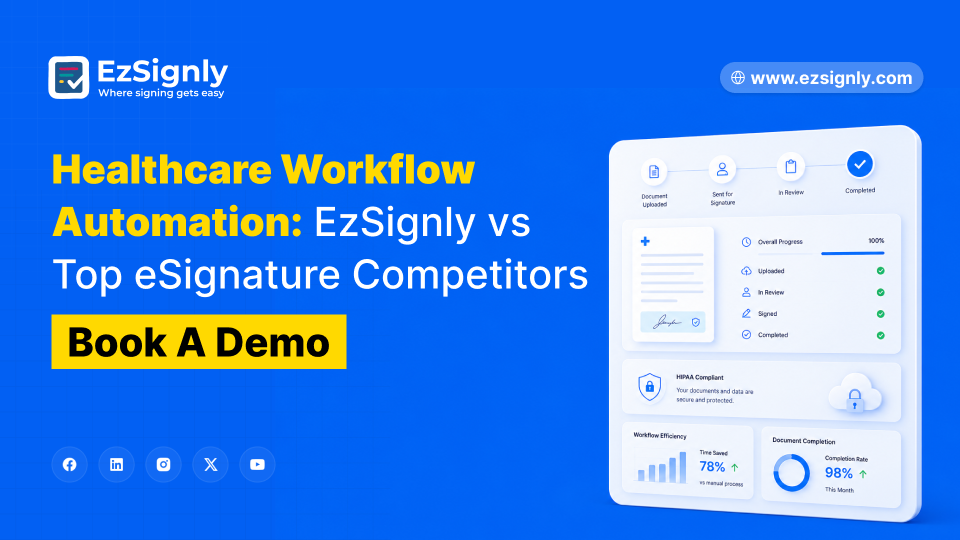
Healthcare Workflow Automation: EzSignly vs Top eSignature Competitors: Book a Demo
Compare EzSignly with top eSignature competitors for secure, HIPAA-compliant healthcare workflow automation.
May 18, 2026
How Electronic Signatures Help Small Businesses Save Time and Money
Electronic signatures help small businesses save time and cut costs by simplifying document signing.
January 27, 2026
Top DocuSign Alternatives 2026: Cut Costs by 80% with Same Features in USA
DocuSign alternatives in 2026 give you the same eSignature features at up to 80% lower cost in the USA. Tools like Dropbox Sign and SignNow are cheape...
March 25, 2026
Legal eSignature Software Tool for Real Estate: Are eSignatures Legal in Illinois?
eSignatures are legal in Illinois and have the same validity as handwritten signatures when both parties consent and proper electronic records are mai...
March 11, 2026
Have any other questions? EzSignly's team is here to help!
© 2026 Copyright EzSignly. All Rights Reserved