


Confidently Go Digital: eSignature Legal & Security Rules in the USA & India – Free Demo
April 24, 2026 | Posted By Admin
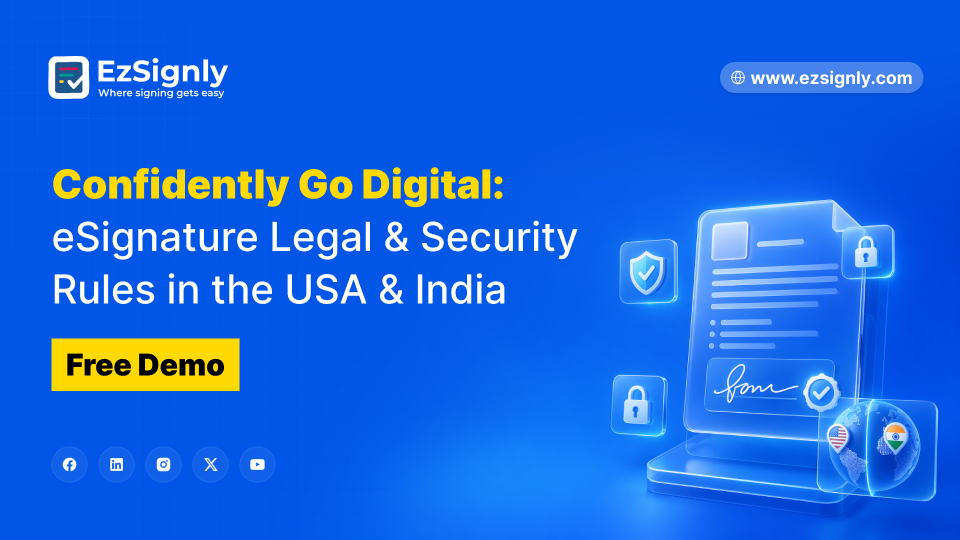
Esignature Tool For Legal Documents
Introduction
Digital transformation within the legal ecosystem is no longer optional; it is a structural necessity. From cross-border agreements to high-volume HR onboarding, organisations are increasingly adopting electronic signatures to reduce friction, accelerate turnaround times, and maintain regulatory alignment. But the move to digital execution raises an important question: how can businesses make sure that they are legal, compliant, and secure in places like the United States and India?
In this article, we explore key electronic signature laws & regulations, which explain how small and medium-sized businesses (SMBs) can adopt secure, cost-effective solutions without
compromising law compliance.
The Legal Foundation of eSignatures
In the United States and India, electronic signatures receive legal recognition, provided they meet specific conditions. However, the governing frameworks differ in structure and application.
United States: ESIGN Act and UETA
The Electronic Signatures in Global and National Commerce (ESIGN) Act of 2000 and the Uniform Electronic Transactions Act (UETA) (which most states have adopted) are the two main laws in the U.S. that give electronic signatures legal weight.
These laws establish that:
Electronic signatures cannot be denied legal effect just because they are digital; all parties must agree to do business electronically; and records must be kept in a way that makes them simple to access and copy. From a business perspective, these laws make sure that contracts signed digitally are just as legally binding as contracts signed by hand, as long as there are audit trails and authentication measures in place.
India: Information Technology Act, 2000
The Information Technology Act (2000) is India's main
law. Some cases allow people to use electronic signatures. Aadhaar-based eSign
and other government-approved methods of authentication are allowed, and
electronic execution is not permitted for some documents, such as wills and
powers of attorney. Those doing business in India must choose platforms that
use legally recognised authentication frameworks.
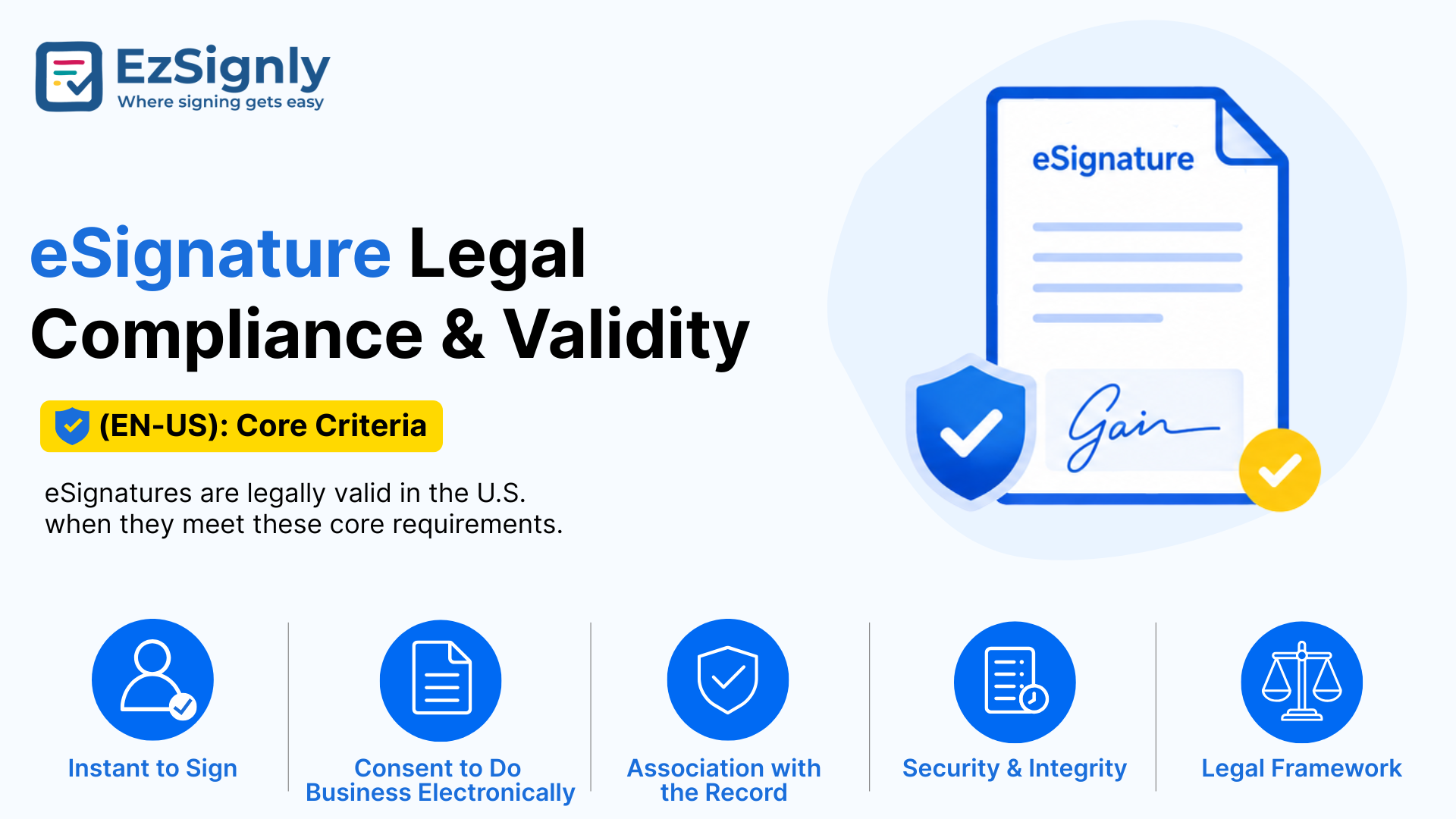
eSignature Legal Compliance & Validity (EN-US): Core Criteria
Across both jurisdictions, legal validity depends on four fundamental pillars:
Failure to meet any of these conditions may compromise
enforceability, particularly in high-stakes legal or financial transactions.
Best Electronic Document Signing
Security Protocols: Protecting Digital Transactions
“Security builds trust. Trust sustains scale.”
Legal compliance alone is insufficient without robust security architecture. Leading eSignature platforms deploy multiple layers of protection:
- End-to-end encryption to safeguard document integrity
- Multi-factor authentication (MFA) to verify user identity
- Tamper-evident seals to detect unauthorised changes
- Role-based access controls to limit document visibility
These safeguards are non-negotiable in sectors like real estate and legal services, where sensitive data frequently exchanges hands.
For instance, adopting solutions designed for secure
real estate e-signing online ensures that high-value agreements remain
protected while maintaining compliance across jurisdictions.
SMB Perspective: Why Affordability Matters
Small and medium-sized businesses often have a harder time than larger businesses when they switch to enterprise-grade tools. Many platforms offer advanced features, but their pricing tiers don't fit with SMB budgets.
Key Challenges:
- High per-user or per-document costs
- Rigid subscription models
- Limited scalability without cost escalation
This scenario is where an affordable e-signature strategy becomes critical. SMBs require solutions that deliver:
- Transparent pricing structures
- Flexible usage plans
- Core compliance features without unnecessary add-ons
Understanding E-signature pricing explained helps organisations evaluate cost against actual usage, avoiding overinvestment in underutilised features.
Use Cases Across Departments
“Digital signatures are not a tool—they are an operational backbone.”
1. Human Resources
HR departments benefit significantly from streamlined workflows, particularly in onboarding and compliance documentation. Solutions tailored for eSignature software for HR in the USA enable:
- Faster offer letter approvals
- Remote onboarding
- Automated policy acknowledgements
2. Legal Teams
Legal professionals require precision, traceability, and enforceability. eSignatures reduce turnaround times for:
- Contracts
- NDAs
- Cross-border agreements
3. Sales and Business Development
Instant execution of agreements accelerates sales cycles, eliminating delays caused by physical documentation.
4. Personal and Entrepreneurial Use
Freelancers and small business owners can leverage e-signature
plans for personal and business purposes to formalise agreements without
incurring enterprise-level costs.
A Practical Approach for the Global Legal Sector
Best practices include platforms that support
compliance across multiple jurisdictions, auditable trails for cross-border
transactions, and data residency requirements for document storage. For legal
professionals working with international clients, ensuring eSignature legal
compliance & validity (EN-US) becomes even more critical, as documents
must often meet multiple regulations.
This approach not only minimises legal risks but also improves efficiency
across global operations.
Affordable Innovation: A Strategic Advantage
“Cost efficiency is not compromise—it is optimisation.”
Emerging platforms such as EzSignly are addressing the gap between affordability and compliance. By focusing on SMB-friendly pricing and essential legal features, this solution enables organisations to adopt digital workflows without financial strain.
Unlike traditional vendors that prioritise enterprise
clients, EzSignity aligns its offerings with the practical needs of growing
businesses, ensuring that compliance and security remain more accessible than
premium features.
Why a Free Demo Matters
A free demo is not merely a marketing tool—it is a risk mitigation strategy. It allows organisations to:
- Evaluate compliance features in real scenarios
- Test user experience across teams
- Assess integration capabilities
For the global legal sector, this step is particularly
valuable in validating whether a platform meets jurisdiction-specific
requirements before full-scale deployment.
Have any other questions? EzSignly's team is here to help!
Conclusion
The adoption of electronic signatures is accelerating across industries, driven by the need for efficiency, scalability, and global collaboration. However, successful implementation requires more than convenience—it demands a structured approach to legal compliance, security, and cost management.
By understanding the nuances of electronic signature laws & regulations and prioritising eSignature legal compliance & validity (EN-US), organisations can confidently transition to digital workflows. When combined with affordable, SMB-focused platforms, this shift becomes not only feasible but strategically advantageous.
A secure, compliant, and cost-effective eSignature
solution is no longer a competitive edge—it is a baseline requirement for
operating in a digitally connected legal landscape.
FAQs
1. Are electronic signatures legally valid in both the USA and India?
Yes. Electronic signatures are legally recognised under the ESIGN Act and UETA in the United States and the Information Technology Act (2000) in India, provided compliance requirements such as consent, authentication, and audit trails are met.
2. What makes an e-signature secure?
Security depends on encryption protocols, authentication methods, and tamper-evident audit trails. Multi-factor authentication and secure storage further enhance protection.
3. Can SMBs afford compliant eSignature solutions?
Yes. Many modern platforms offer scalable and transparent pricing models tailored for SMBs, enabling legal compliance without excessive costs.
Take a look at the latest blog
Why Businesses Are Adopting E-Signatures—Pros, Cons, and Real-World Use Cases
E-signatures help companies sign documents instantly, reduce paperwork, and improve efficiency across teams.
January 27, 2026
Go Paperless Today: Schedule Your Cloud-Based eSignature features Demo
Go paperless today with our cloud-based eSignature solution. Schedule a demo to discover how you can streamline document workflows, reduce costs, and ...
April 7, 2026
Experience Faster Legal Approvals with the Right eSignature Solution for Your Chicago Firm – Book a Demo
Speed up legal approvals with a secure eSignature solution for Chicago law firms. Reduce delays, simplify signing, and book a demo today.
June 25, 2026
What is an eSignature? How It Works, Its Benefits, and Are They Legal?
An eSignature is a secure digital way to sign documents online — fast, paperless, and legally valid.
January 29, 2026
Have any other questions? EzSignly's team is here to help!
© 2026 Copyright EzSignly. All Rights Reserved