


From Paper to Digital: Why Businesses Choose EzSignly eSignatures
January 27, 2026 | Posted By Admin
Paperless Signing Tool
For a long time, traditional paper-based signing has been the standard way to execute business contracts; that is, a contract document would be created, signed, scanned, and then sent via email or courier service. But eSignature software online has become the standard way for modern businesses to execute contracts faster, more securely, and with full regulatory compliance.
With businesses now operating across various geographical entities, time zones, and distributed teams, the decision processes are increasingly streamlined, traceability is a necessity, and regulatory compliance is growing. Here, the conventional e-signatures look like a limitation in a digital landscape.
This is why organizations are increasingly adopting EzSignly eSignature software online as a core component of their digital operations.
The Limitations of Paper-Based Signing
Paper workflows create friction at every stage of document execution.
Documents must be printed, physically signed, scanned, and sent back. Each step involves a process that introduces delays and opportunities for errors or for omitting pages or versions.
When one grows in a company, such concerns grow exponentially in a burgeoning organization. As the volume of documents grows, so does the complexity of tracking status, especially in searching for the final version of a document, ascertaining signatures, etc.
These limitations are not just operational. They implicate governance, compliance, and risk.
For this reason, paper is now considered an operational cost rather than just an innocent medium.
Why Digital Signing Has Become Standard Practice
The limitations listed above are addressed directly by digital signing.
Document delivery is streamlined with digital signature software, which enables instant processing. It is automatically analyzed and securely archived with every move recorded. The record of signatures and document delivery is automatically recorded.
Today, organizations use eSignature software online across:
- Sales contracts and customer agreements
- HR onboarding and employment documentation
- Legal approvals and regulatory filings
- Procurement and vendor contracts
This provides a controlled execution environment.
Approvals can be predicted.
Tracking is done automatically.
Compliance becomes built in.
This is why more organizations are replacing manual processes with online esignature software online as a core part of their document execution strategy.
Control and Traceability as Primary Drivers
One of the main reasons organizations adopt esignature software online is not speed, but control.
In paper workflows, organizations rely on manual follow-ups and informal tracking. This makes it difficult to answer basic operational questions.
Which agreements are pending? Who is delaying approvals? Which version was signed? When was final execution completed?
Digital signing answers these questions automatically.
Every document has a complete history.
Every signature is time-stamped.
With digital eSignature software, every approval, signature, and version change becomes automatically traceable.
The Role of HR in Driving Adoption
In many companies, the adoption of technology can initiate in the HR department
HR departments handle large volumes of sensitive, time-sensitive documents. Offers to employ individuals, employment contracts, policy acknowledgment forms, and numerous employee onboarding forms must be executed properly and stored safely.
These processes, which were previously time-consuming, can be streamlined through eSignature for HR Operations.The hiring process takes less time.
Remote onboarding would become feasible.
Compliance records are generated automatically.
Other departments then tend to have these same beneficial outcomes.
Security and Compliance in Digital Signing
Today's eSignature systems have multiple security checks in place.
Documents can be sent and stored with encryption.
Access is based on Roles and Permissions.
Signed files are locked against changes.
All activities are recorded automatically.
This reduces the risks of fraud, unauthorized change, and data loss.
This security model may be essential for regulated industries to meet their respective compliance needs.
Why Businesses Choose EzSignly
Moving to standardization, organizations prefer to have platforms that provide ease and control at the same time.
It is engineered to enable business-class performance without unnecessary complexity.
It offers safe encryption, audit-friendly workflows, automation of reminders, mass sending, and a legally safe signing service all within a single platform.
This allows organizations to standardize digital signing across sales, HR, legal, procurement, and operations.
The result is a consistent execution layer across the business.
Operational Impact Over Time
The value of digital signing increases with scale.
As document volume grows, manual tracking becomes unmanageable. Digital workflows, by contrast, become more valuable with repetition.
Turnaround times improve. Administrative effort declines. Compliance becomes easier to maintain. Risk becomes easier to manage.
Over time, these effects compound into measurable operational advantage.
Why Legal Teams Prefer Digital Execution
Legal departments were initially cautious about electronic signatures.
That position has changed significantly.
When organizations eSign Legal Documents Digitally, they gain stronger evidentiary records than paper can provide. These factors like audit trails, authentication, document integrity, make digital agreements highly defensible.
In disputes, digital records can often offer clearer proof than handwriting.
It is because of this that several legal groups currently encourage and/or demand digital signatures.
Digital Signing as the Foundation of Automation
Digital signing usually represents the first step towards automation.
If the documents are made digital, organizations can use technologies like automated contract generation, pre-populated contracts, HR and CRM integration, and intelligent compliance tracking.
In this sense, digital signing is not an end product.
They have a foundation.
This future cannot be created by paper workflows.
Have any other questions? EzSignly's team is here to help!
Final Thoughts
For most organizations today, the question is no longer about whether digital signing works. That question has already been answered.
The real question is whether it still belongs in a business that expects predictability, auditability, and scale.
For each and every one of your paper-based workflows, a little uncertainty is injected into decisions that would otherwise lack a grey area. Every manual approval weakens traceability.
Each informal process will become less easy to justify as volumes grow.
Organizations move to eSignature software online not to digitalize, but to professionalize their execution. They choose digital eSignature Software to ensure results are consistent. They implement eSignature to optimize their hr operations to ensure their hiring is scalable.
They eSign legal documents digitally to ensure their risks are calculable, not assumed.
They select EzSignly because experienced companies are run by systems rather than habits.
Sign up for a free account today to introduce structure, accountability, and control into all contractual arrangements.
Take a look at the latest blog
Why EzSignly is the Smart Choice for The Best Online eSignature Tool
EzSignly is here to help you navigate hoards of contracts, agreements, offer letters, NDAs, etc, at a fraction of the cost.
January 23, 2026
How does eSignature Help the Digital Document for Daily Small Businesses
This is where EzSignly becomes operationally essential. By employing the use of the eSignature software for digital document workflow, small businesse...
January 13, 2026
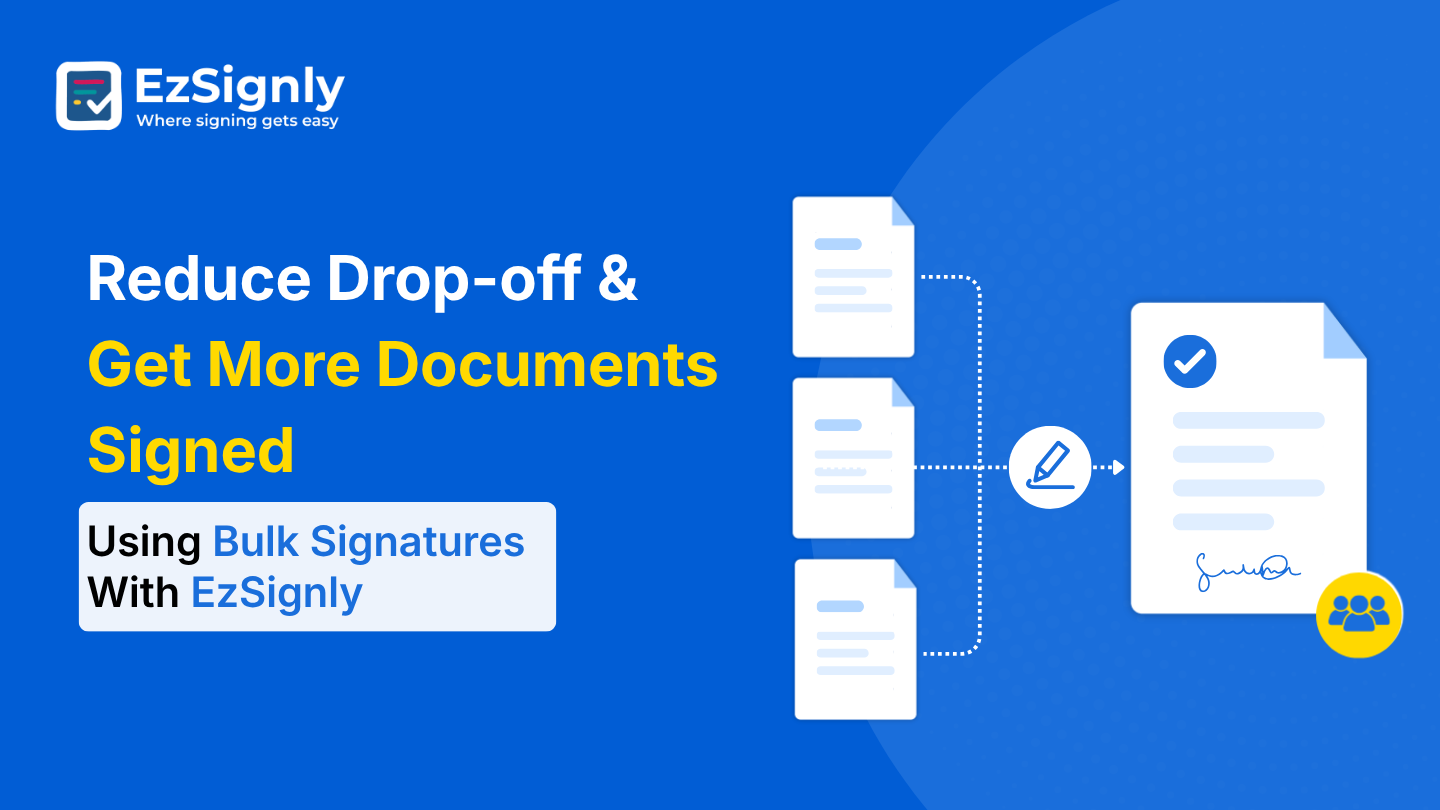
Reduce Drop-off & Get More Documents Signed Using Bulk Signatures With EzSignly
Use EzSignly Bulk Signatures to increase document completion. Reduce drop-offs, expedite approvals, and send several documents at once.
August 5, 2026
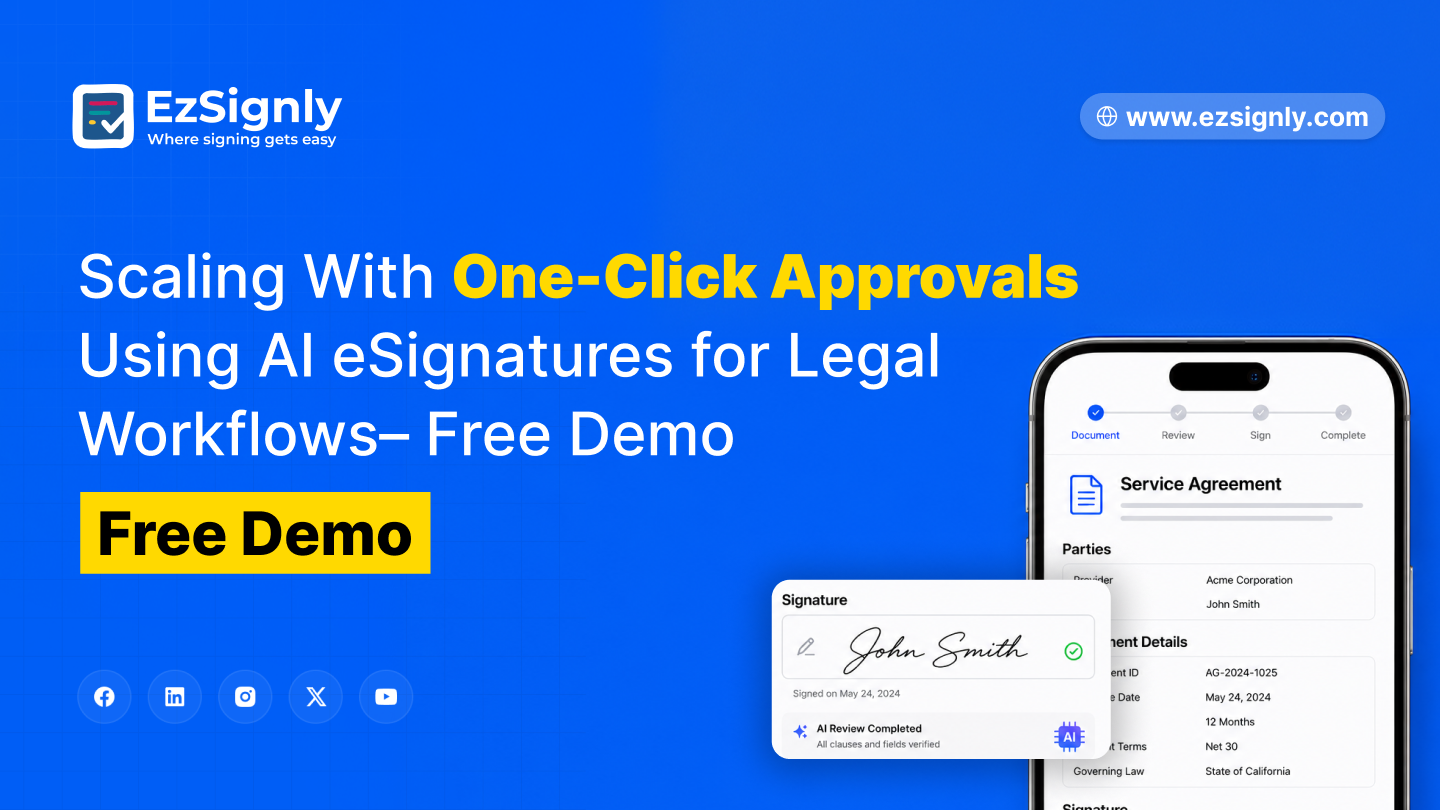
Scaling With One-Click Approvals Using AI eSignatures for Legal Workflows– Free Demo
Scale legal workflows with AI-powered eSignatures and one-click approvals for faster, secure document processing.
May 6, 2026
Have any other questions? EzSignly's team is here to help!
© 2026 Copyright EzSignly. All Rights Reserved