


Healthcare Workflow Automation: EzSignly vs Top eSignature Competitors: Book a Demo
May 18, 2026 | Posted By Admin
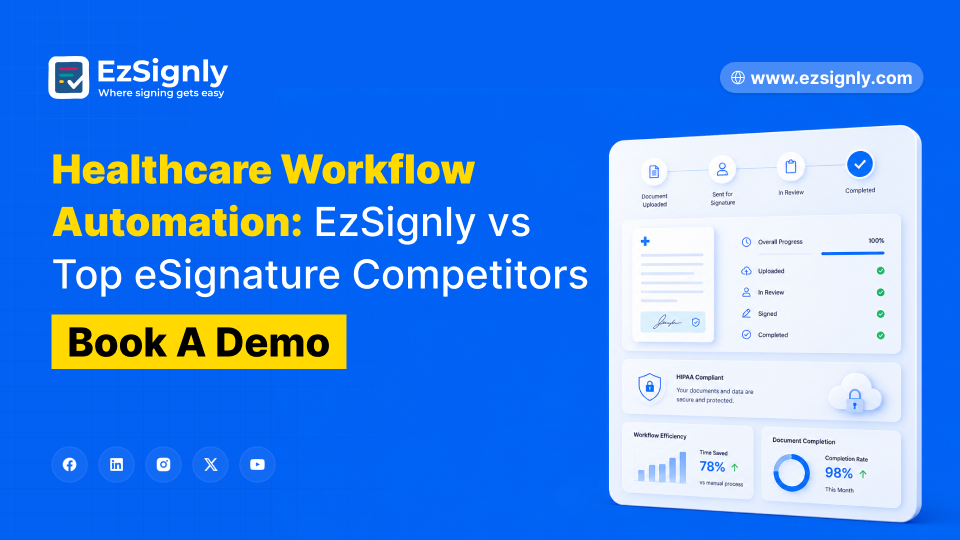
Best eSignature Software
Summary
The workflow automation has expanded much more than
just document digitisation in the healthcare world. Platforms handling patient
registration, consent forms, provider enrolment, approval of referrals, claims,
and compliance are part of the daily routine for hospitals and clinics. The big
question now is, for 2026, which e-signature platform best fits the criteria in
terms of workflow automation, healthcare compliance, extensibility and
scalability without adding administrative overhead? Companies such as EzSignly
are competing with bigger companies with their focus on workflow automation,
audibility and audit readiness, batch workflow handling, and affordable
pricing.
Introduction
In the healthcare industry, providers are facing a
greater demand to cut down on paper, meet compliance standards and onboard new
patients as quickly as possible. The entirety of healthcare relies on moving
approvals from insurance verifications and consent forms to employee and vendor
contracts, which means faster processes and enhanced security over
documentation. Due to this, many organisations are using e-signature
software for Business in Chicago and for businesses nationwide to
increase the pace of approvals. Though a large number of platforms have already
made enterprise available, like DocuSign, Adobe and Dropbox, this platform
separates itself through its low costs, streamlined workflow automation and
accessible interface for the modern healthcare profession.
The Challenges of Traditional Healthcare Finance Workflows
In addition to these limitations, manual, offline
healthcare finance workflows also have to overcome inefficient, error-prone
processes such as insurance verification, claims processing, repayments and
approval management. Many healthcare organisations may struggle to gain
much-needed visibility into payment processing and finances due to manual,
paper-based workflows that are disconnected, thereby increasing chances of
payment delays, errors, compliance issues and lost documents. Furthermore,
collaboration in finance, HR, procurement and legal departments, compared to
the workflow of modern automation platforms such as our software tool, becomes
less efficient with paper-based healthcare financing workflows.
The Role of AI in Healthcare Finance Workflow Automation
AI is reshaping healthcare finance workflows by
automating document management, alleviating administrative burden, and
enhancing workflow efficiency and accuracy. Advanced AI-enabled systems are now
capable of extracting data from invoices, insurance forms, and reimbursements
and will even automatically route workflows for approval to the relevant
departments. AI will assist healthcare institutions in managing payment delays,
managing compliance concerns and enhancing financial transparency with the use
of predictive analysis. Leading platforms such as this electronic signing
software are building in AI-driven workflow automation in order to streamline
approvals, documentation and audit trail compliance for healthcare teams.
Why Does Healthcare Need Workflow Automation Right Now?
Even though the healthcare has adopted the technology so much, the management has still operated manually. Chasing approval signatures from emails, printing a form and then asking a patient to sign it or manually tracing the approved documents. Such processes delay service and diminish patient experience.
Automation of the workflows, however, transforms this process entirely. Sending documents digitally isn't all there is, and healthcare providers can also automate:
- Patient Intake & Consent Forms
- Insurance Verification Processes
- Purchase & Procurement Approvals from Vendors
- New Employee onboarding documents
- HIPAA Acknowledgement forms
- Patient Payments & Reimbursement Approvals
When contrasted with traditional enterprise
applications that often involve lengthier onboarding procedures, this software
automation takes things a step further and is simpler to use with
functionalities such as bulk sending, templating, signing sequence ordering,
and tracking in real-time.
The Shift From Basic eSignatures to Intelligent Automation
Traditional eSignature platforms were developed with
only one use case in mind – helping business processes go paperless by
digitising signatures. However, today, the demands on healthcare operations are
significantly more complex; in order to be able to streamline operations, stay
compliant, and scale, an eSignature platform needs to be more than just
electronic signing software.
The best solutions offer things like automated reminders, intelligent document
routing, role-based permission levels, tamper-proof audit trails,
intra-departmental cooperation and intelligent workflows managed with the help
of AI. Workflow-orientated platforms are fundamentally different from
traditional competitors. While PandaDoc and HelloSign focus more heavily on
sales contracts and managing proposals, our software focuses on scalable
operational workflows for HR, legal, health and growing businesses.
Healthcare Compliance Is Now a Competitive Advantage
Of all these document management concerns for
healthcare, the compliance area presents the most critical challenges due to
the sensitive nature of patients’ records and healthcare agreements. The
information therein must be secure, admissible and verifiable. Encryption, safe
data storage, tamper-resistant document management, regulated access and
controls, compliant audit trail capabilities, and overall compliance readiness
are being emphasised by many healthcare providers. Historically, the discussion
of enterprise compliance has revolved around systems such as DocuSign; however,
younger systems such as our e-signing tool are enabling workflows centred
around compliance with business practices without the top-tier enterprise
price. Healthcare HR departments managing credentialing and hiring have access
to dedicated eSignature Software for HR in Chicago to
facilitate workflow management, employee documentation and policy
acknowledgements.
Comparing EzSignly With Top eSignature Competitors
The digital transformation of document workflows within healthcare organisations means that the decision on which eSignature platform to use is a more critical choice, requiring the vendor to satisfy compliance, automation, scalability, and price needs. The established solutions tend to have strong enterprise functionality, and many smaller, fast-growing healthcare organisations are on the lookout for solutions that are quick to set up, easy to manage, and scalable at an affordable price. Our AI software positions itself as a workflow-driven alternative which offers both regulatory-compliant digital signing and ease of use through automation.
| Comparison | Competitors' Strengths | How Our tool Differentiates |
| Vs. DocuSign | DocuSign is widely recognised for enterprise-grade integrations and global adoption. However, many mid-sized healthcare providers find its pricing and feature structure difficult to scale affordably. | This software focuses on simplified deployment, transparent pricing, workflow automation, and SMB-friendly scaling while still supporting compliance-focused digital signing. |
| Vs Adobe Sign | Adobe Sign integrates deeply with PDF ecosystems and enterprise document management systems, making it suitable for enterprises already operating within Adobe environments. | Our software emphasises operational simplicity, automated document workflows, and easier team collaboration for growing healthcare organisations. |
| Vs Dropbox Sign | Dropbox Sign provides lightweight digital signing capabilities suitable for basic workflows. However, healthcare organisations often require stronger workflow orchestration and compliance tracking. | It differentiates itself with AI-powered automation, bulk sending, centralised dashboards, and audit-ready tracking. |
| Vs PandaDoc | PandaDoc performs strongly in proposal workflows and sales-focused automation. | Our AI tool is designed for operational workflows across HR, healthcare, legal, and real estate teams, making it more adaptable for healthcare administration and patient-facing documentation. |
Automation Helps Reduce Administrative Burnout
A key operational issue for administration in healthcare is how to overcome administration burnout from endless searches and paperwork of unsigned forms and approvals as well as disconnected documents. The tedious, repetitive process that each one entails delays efficiency, taking time away from medical staff's ability to care for patients.
In order to alleviate the workflow bottleneck and free
up medical professionals to attend to their patients' needs, eSignature
automation can be utilised. The functionality of automatic reminders and status
tracking, centralised document dashboards, bulk distribution and secure digital
filing make this an obvious and effective solution. E-signature automation is a
much more efficient tool for workflow than traditional paper processes are. Any
company that is required to deal with property transfer and medical facility
agreements can use a solution like Secure Real Estate eSigning Online for
bulk, high-volume document approval and execution.
Transforming Healthcare Operations Faster
Healthcare organisations that continue relying on manual documentation processes risk slower approvals, compliance gaps, higher operational costs, and increased employee burnout.
The market is shifting toward unified workflow ecosystems where document automation, digital signatures, compliance management, and AI-powered assistance work together on one platform.
While enterprise giants like DocuSign and Adobe continue dominating large enterprise deployments, emerging platforms like our electronic signing tool are attracting growing healthcare teams by prioritising affordability, workflow automation, operational simplicity, and scalable collaboration.
Healthcare workflow automation is no longer about
replacing paper signatures. It is about building faster, smarter, and more
compliant healthcare operations that can scale efficiently in a digital-first
environment.
Have any other questions? EzSignly's team is here to help!
Why Cost Transparency Matters in Healthcare Technology
Healthcare professionals are moving beyond the basic feature sets when choosing software and starting to scrutinise operational ROI instead. Hidden fees, limits in scale and pricing per envelope can add up quickly.
This e-signing software tool points out it offers clear pricing structures ideal for start-ups, small businesses, and growing companies. Features such as mass sends, templates, user role assignments and tracking of workflows are packaged in affordable, flat rates.
When comparing subscription plans, healthcare
organisations need to investigate e-signature plans and pricing to
find out which automation solution best suits the operational requirements.
How EzSignly AI Can Help in Healthcare Finance Automation
This AI assists healthcare facilities in automating
their finance workflows through simplified approvals, signatures, and payments.
Such as a decrease of paper document usages by using eSignatures supported by
AI, automatic reminders, centralisation of document repositories, and so on.
These make the finance team efficiently process things like invoices, vendor
agreements, insurance claims and expense reimbursements in a more accurate and
timely way and also increase the compliance level. This reduces administrative
work and delays to help finance departments work more efficiently.
FAQs
Q: How long does workflow automation take to implement?
A: Implementation timelines depend on workflow complexity and integration requirements. Small healthcare teams may deploy automated eSignature workflows within a few days, while enterprise healthcare systems with multiple departments and integrations may require several weeks.
Q: What is the difference between an RPA and an AI agent in the healthcare setting?
A: Robotic Process Automation (RPA) can automate routine tasks based on pre-programmed rules, such as routing documents, performing data entry, etc. But an AI agent goes beyond by analysing data patterns, determining workflows, recommending actions and responding to the fluctuating workflows.
Q: What are the initial steps to apply AI to the field of health care finance?
A: First, healthcare organisations need to find repetitive finance tasks like claims approval, bill processing, reimbursement auditing, and regulatory reporting. Then, choose safe automation platforms that can work together with other healthcare organisations' systems and compliance standards.
Q: Why are healthcare providers adopting automated e-signature platforms?
A: Healthcare providers adopt automated e-signature solutions to reduce paperwork delays, improve compliance tracking, enhance patient experiences, accelerate approvals, and minimise operational costs associated with manual document management.
Take a look at the latest blog
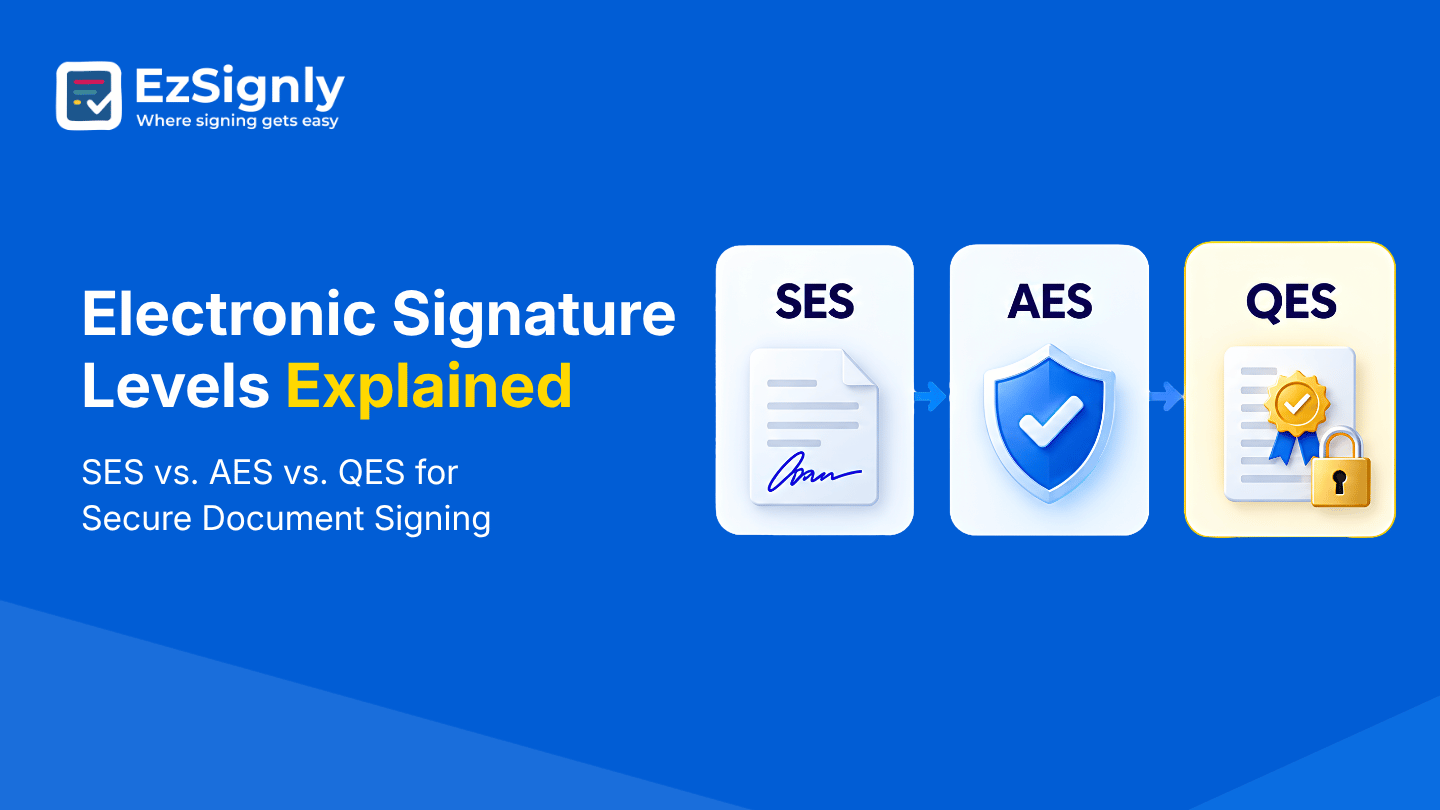
Electronic Signature Levels Explained: SES vs. AES vs. QES for Secure Document Signing
A comprehensive legal guide that explains the distinctions, security levels, and legal validity of SES, AES, and QES for secure electronic document si...
September 15, 2026
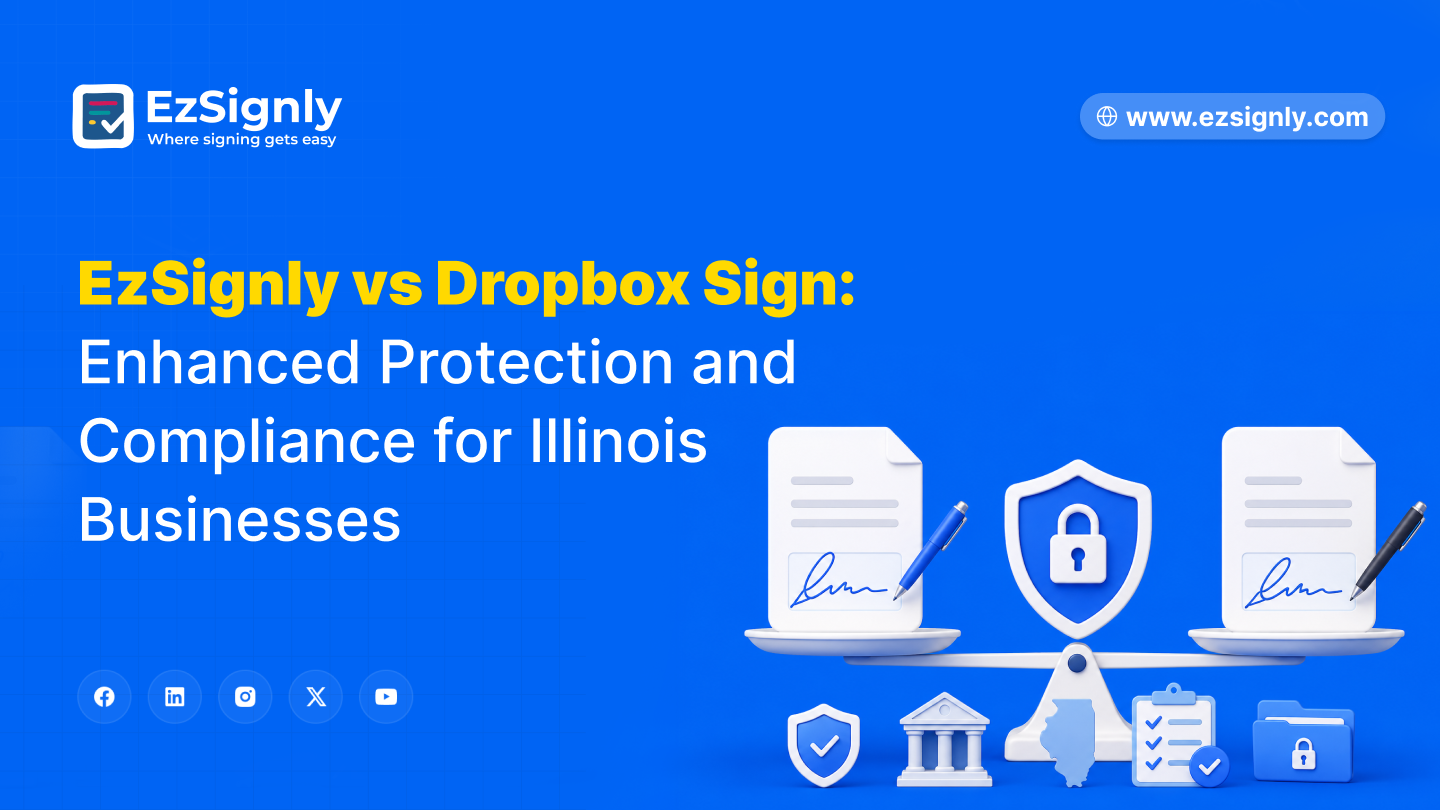
EzSignly vs Dropbox Sign: Enhanced Protection and Compliance for USA Businesses
Choose EzSignly for enhanced document protection and compliance beyond Dropbox Sign.
June 4, 2026
How Electronic Signatures Are More Effective Than Manual Signatures in 2026
In 2026, e-signatures simplify signing with speed, security, and full digital convenience.
January 30, 2026
From Paper Documents to Seamless eSignatures in Modern Legal Document Management
Move from paper documents to secure, fast digital workflows with seamless eSignatures for modern legal document management.
March 13, 2026
Have any other questions? EzSignly's team is here to help!
© 2026 Copyright EzSignly. All Rights Reserved