


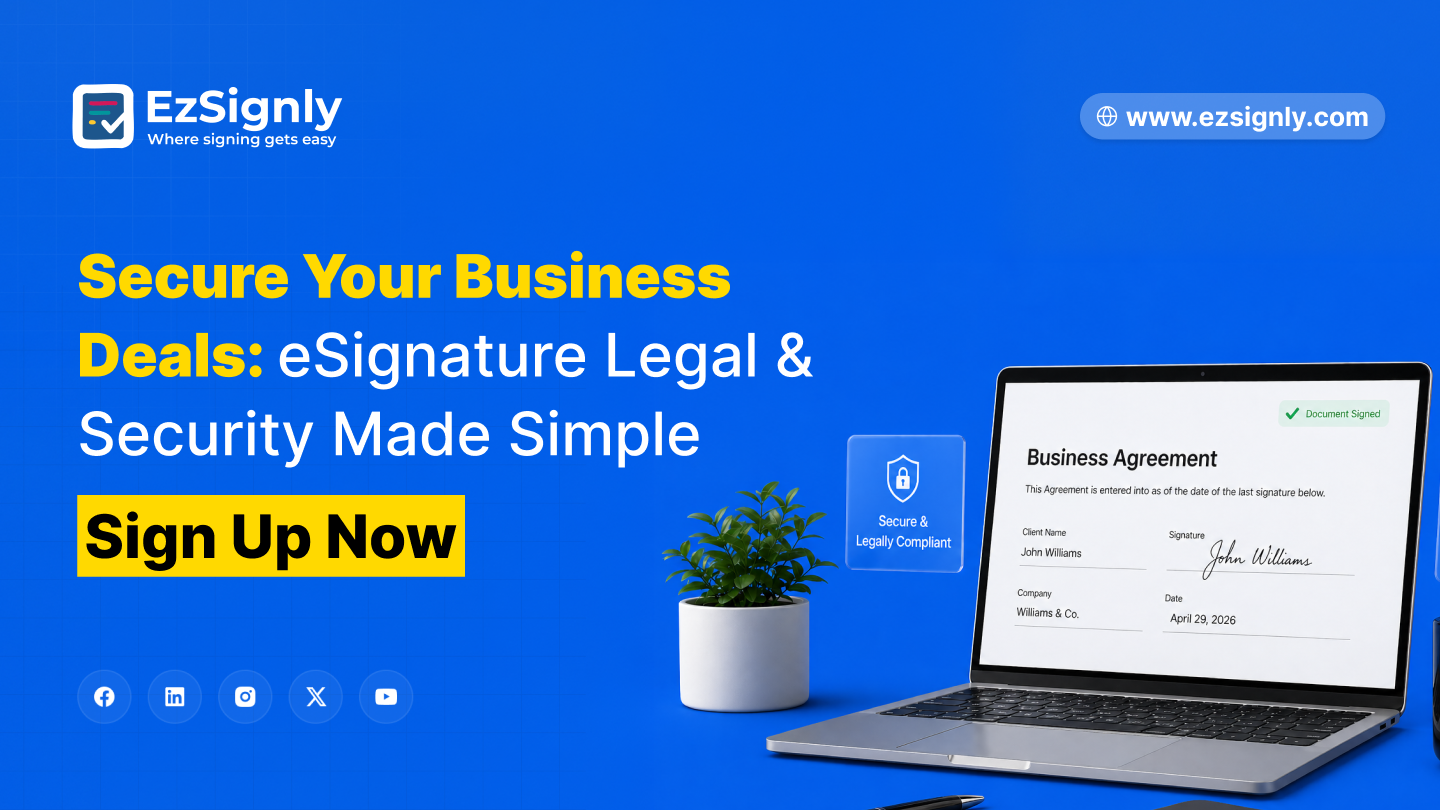
Secure Your Business Deals: eSignature Legal & Security Made Simple-Sign Up Now
April 28, 2026 | Posted By Admin
Best E-Signature Solution For Legal Business
Summary
Closing deals used to mean printing stacks of paper,
hunting down signatures, and praying nothing got lost in transit. Now it takes
a few clicks. But speed creates a new problem for legal teams, when a dispute
hits, does that digital signature actually hold up? This guide cuts through the
noise on eSignature law, compliance, and security so your team knows exactly
what it takes to keep every agreement bulletproof.
Table of Contents
- Introduction
- The Laws Behind eSignature Enforcement
- Sector Regulations That Change the Game
- The Four Things That Make a Signature Valid
- Security: What Actually Matters
- Real-World Applications by Industry
- Choosing a Platform That Works
- Conclusion
- FAQs
The Confidence Problem Nobody Talks About
Most legal teams have already switched to electronic signatures. What does not get discussed as often is the question sitting underneath all of that: are these signatures actually solid if someone decides to challenge them? The workflow improvement with legal e-signature software alone makes the case, faster turnarounds, no more chasing people down hallways, and documents that do not disappear into someone's inbox.
It is a fair thing to worry about. Not every eSignature is created equal, and not every platform handles compliance the same way. A signature collected without proper consent documentation, without identity verification, or without a tamper-proof audit trail can be challenged in court, and sometimes successfully. For teams managing contracts across multiple states and industries, that is not a theoretical risk. It is a real one.
Here is what actually protects you: understanding the
legal framework well enough to demand the right things from your tools and your
process.
The Laws That Make eSignatures Stick
Two federal laws form the foundation of eSignature enforceability in the USA.
The ESIGN Act, which was signed into law in 2000, said that an electronic signature is just as valid as a handwritten one in business between states and countries. The main idea is simple: you can't refuse to honor a contract just because it was signed electronically. The law also requires that parties actively consent to electronic transactions, which sounds like a formality but becomes important evidence if a dispute ever arises.
UETA, the Uniform Electronic Transactions Act, covers intrastate transactions and has been adopted by 49 states. New York runs on its own ESRA framework, which covers similar ground. Between ESIGN and UETA, the legal basis for electronic signatures is well established across the country.
What these laws do not do is guarantee that every
electronic signature is valid. They validate the concept. The process still has
to be right. That gap, between what the law permits and what actually holds up,
is where legal teams need to stay sharp.
Sector Regulations That Raise the Bar
Federal eSignature law sets the floor. For most industries, there is a ceiling they also have to reach.
Healthcare is one of the most demanding environments. Any platform handling patient consent forms, provider contracts, or telehealth documentation has to align with HIPAA, which means encrypted storage of protected health information, strict access controls, and a signed Business Associate Agreement with the platform vendor. Skipping that last step creates federal privacy exposure.
Pharmaceutical and biotech companies have to contend with FDA 21 CFR Part 11, which governs electronic records in regulated manufacturing and research settings. This regulation requires closed system controls, full audit trails, and the ability to reproduce accurate printed copies of signed records on demand. The consequences of non-compliance reach well beyond a single contract.
The SEC and FINRA watch over financial services
companies, and they have their own rules about how to keep records. For
example, documents must be stored in systems that keep them safe and make them
easy to find for the full retention period. In this case, electronic
signature laws and regulations cover more than just the act of signing;
they also cover what happens to the document after it is signed.
The Four Things That Make a Signature Legally Valid
Knowing that eSignatures are permitted is one thing. Knowing whether a specific signature will survive a challenge is another. Courts that have looked at eSignature disputes tend to focus on the same four factors every time.
- Intent. Did the signer take a deliberate action to sign? Clicking a button, drawing a signature, typing a name, any of these works, as long as it is clear the person understood they were executing a legal document, not just clicking past a screen.
- Consent. Did both parties agree to conduct business electronically? Most platforms capture this through a disclosure shown before signing begins. It feels like a small step, but if a party later claims they never agreed to electronic contracting, that disclosure record is what settles the argument.
- Document integrity. The signed version of a contract needs to be preserved exactly as it was at the moment of signing. Tamper-evident sealing ensures that any alteration made afterward becomes immediately detectable. Without it, the authenticity of the signed document becomes a legitimate question.
- Audit
trail. A complete log of every event like,
document sent, opened, signed, completed, along with timestamps, IP
addresses, and device information is what transforms eSignature legal
compliance and validity from an abstract concept into something you
can actually put in front of a judge. Platforms that do not generate this
kind of documentation are a liability.
Security: What to Actually Look For
A platform can be legally compliant and technically insecure at the same time. Both matter. When evaluating any legal eSignature software tool online, there are a few things worth treating as non-negotiable. Encryption should be AES-256 at rest and TLS 1.2 or higher in transit. This is baseline, not advanced. Any platform that cannot confirm this should be off the list immediately.
Identity verification is where platforms diverge significantly. Email-based authentication works for lower-stakes documents. For anything high-value, look for SMS one-time passwords, knowledge-based authentication, or government ID verification. The stronger the identity check at signing, the harder it is for someone to later claim the signature was not theirs.
Audit trails need to be comprehensive and tamper-proof
themselves. Every event in the signing lifecycle should be logged. The
completed document should carry a digital certificate seal, if anything changes
after signing, that seal breaks and the tampering is visible. This is not a
nice-to-have feature. It is the mechanism that makes your signatures
defensible.
How This Plays Out in Practice in Different Industries
The compliance requirements look different depending on what your organization actually does.
HR teams deal with high volumes of time-sensitive documents. Offer letters, NDAs, policy acknowledgments, onboarding packets, the list is long and the pace is fast. Good eSignature software for HR in the USA does not just collect signatures. It integrates with existing HR systems, enforces consistent workflows across offices and states, and handles the state-specific requirements built into certain employment agreements without someone having to remember to check.
Real estate operates on a different kind of pressure. Transactions involve multiple parties, often in different locations, signing in a specific sequence with hard deadlines attached. The ability to use secure real estate eSigning online has changed how closings work, when the platform supports multi-party workflows and remote online notarization, an entire transaction can be completed digitally without losing any legal standing. Most states now recognize RON, and that number keeps growing.
Legal and professional services firms bring
confidentiality concerns that go beyond what most platforms are configured for
by default. Access controls, restricted document visibility, and custom signing
workflows matter here. So does the ability to present a white-labeled signing
experience, clients should not have to navigate someone else's software
branding to execute an engagement letter.
Have any other questions? EzSignly's team is here to help!
Picking a Platform That Actually Fits
Compliance credentials are necessary but not sufficient. A platform your team finds clunky will get worked around, and workarounds create compliance gaps. The tool has to function well in practice.
For day-to-day use, multi-party signing sequences, conditional fields, reusable templates, and automatic reminders for outstanding signatures should all be standard. If you are managing high-volume document workflows, the time savings from good template functionality alone justify the investment.
Pricing structures across most platforms follow the same general pattern. Individual plans include basic signing for low-volume or solo use. Mid-tier plans in EzSignly add team management, and template libraries, which are good for most legal or HR departments.
Enterprise plans add advanced authentication, SSO, dedicated support, and the formal compliance documentation, SOC 2, ISO 27001, HIPAA BAAs, that regulated industries need. When comparing eSignature plans for personal and business needs, it all comes down to how many signatures you need and what level of compliance your industry needs.
On the cost question: e-signature pricing explained
honestly means recognizing you are not just paying for a signature button.
You are paying for the audit infrastructure, the security architecture, and the
compliance documentation that turns a click into an enforceable agreement.
Cheapest is rarely the right metric here.
Close Every Deal With Confidence
Electronic signatures work. The law is clear, the technology is mature, and organizations that implement them correctly are closing deals faster and with stronger documentation than anything a paper process could produce. The challenge is not whether eSignatures are valid, it is whether your specific signatures are done right.
Legal eSignature tools that nail this are not just more efficient. They are more protected. Every contract has a complete record behind it, every audit trail is already built, and every challenge to a signature's validity meets a wall of documented evidence.
If there are gaps in your current approach, now is the time to fix them.
Sign up on EzSignly today and see what a
properly built eSignature process actually looks like.
FAQs
Q1: Are there documents that still require a handwritten signature?
Yes. Wills, adoption orders, certain real estate deeds, and documents requiring notarization in states without remote online notarization laws still need pen-and-ink signatures. The list varies by state and changes as RON legislation expands, so it is worth reviewing jurisdiction-specific exclusions regularly.
Q2: What happens if someone claims they never agreed to sign electronically?
The consent record and audit trail answer that question. A compliant platform captures the exact moment a signer accepted the electronic disclosure, along with the device, IP address, and timestamp. That documentation makes a non-consent claim very hard to sustain in front of a court.
Q3: How do I verify a platform is actually compliant and not just saying so?
Ask for independently verified certifications, SOC 2 Type II, ISO 27001, and a willingness to sign a HIPAA BAA if your use case requires it. Self-reported compliance claims are easy to make. Third-party audit certifications are not. Any platform that hesitates on these should not be anywhere near your sensitive documents.
Take a look at the latest blog
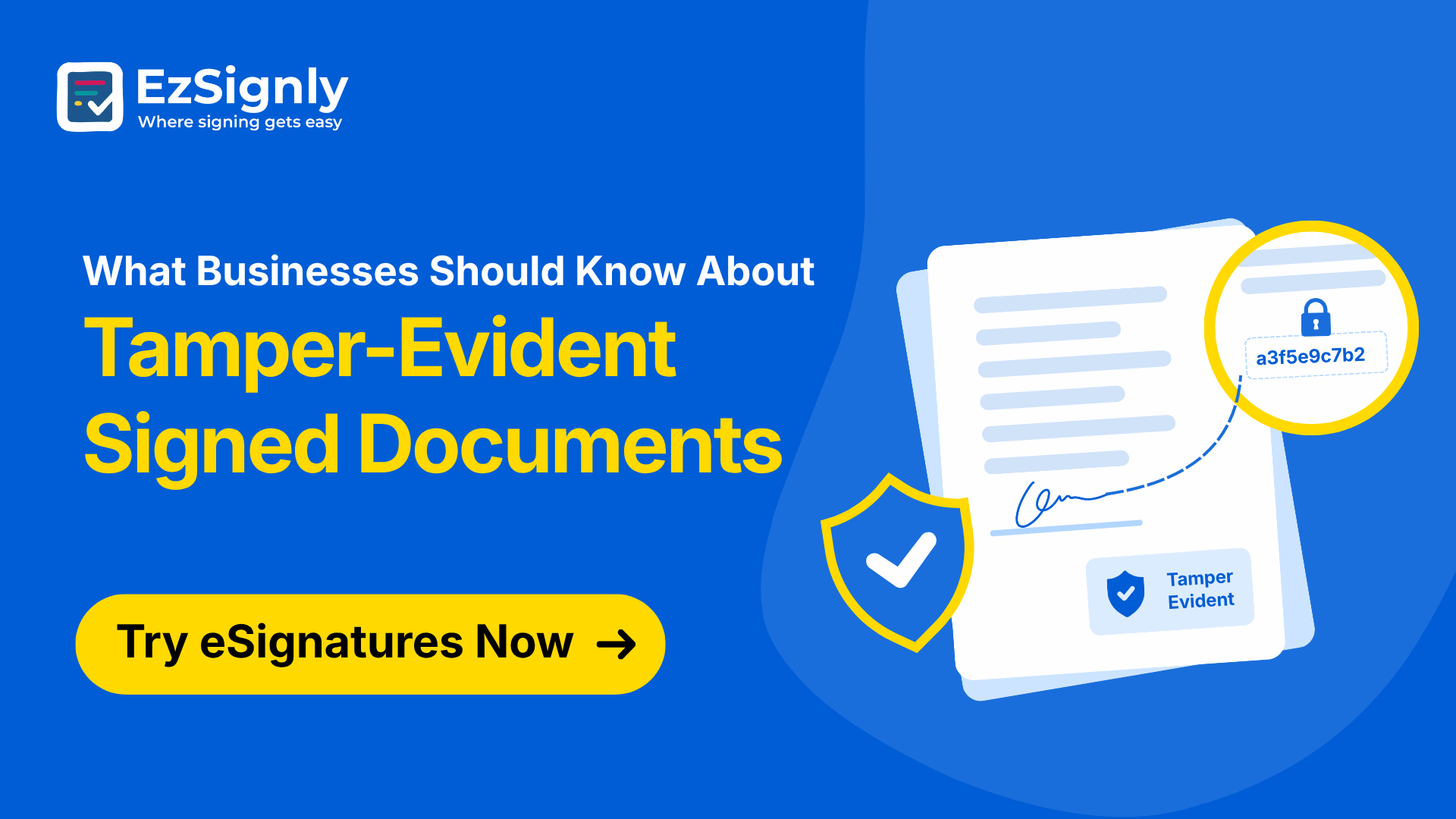
What Businesses Should Know About Tamper-Evident Signed Documents: Try eSignatures Now
Read more about this article...
October 21, 2026
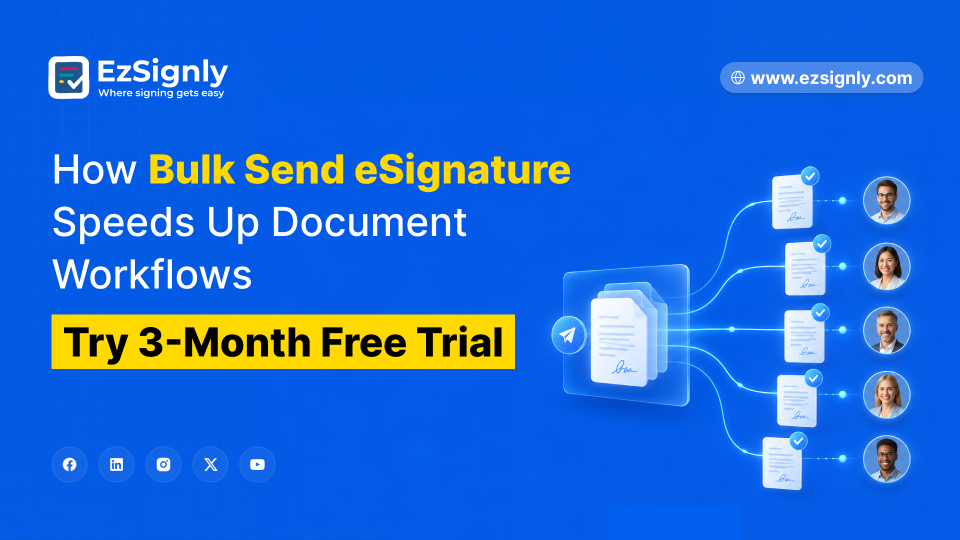
How Bulk Send eSignature Speeds Up Document Workflows – Try 3-Month Free Trial
Speed up document approvals with Bulk Send eSignature and manage hundreds of agreements in minutes. Start your 3-month free trial today and streamline...
May 14, 2026
Boost Productivity: Why Small Businesses Are Adopting Electronic Signatures
The smart way small businesses speed up signing and approvals.
January 27, 2026
Productive Contract Management Tools to diminish Compliance Risks and Delays for Small Businesses
Streamline contracts with productive contract management tools that reduce compliance risks, delays, and manual errors for small businesses.
June 4, 2026
Have any other questions? EzSignly's team is here to help!
© 2026 Copyright EzSignly. All Rights Reserved