


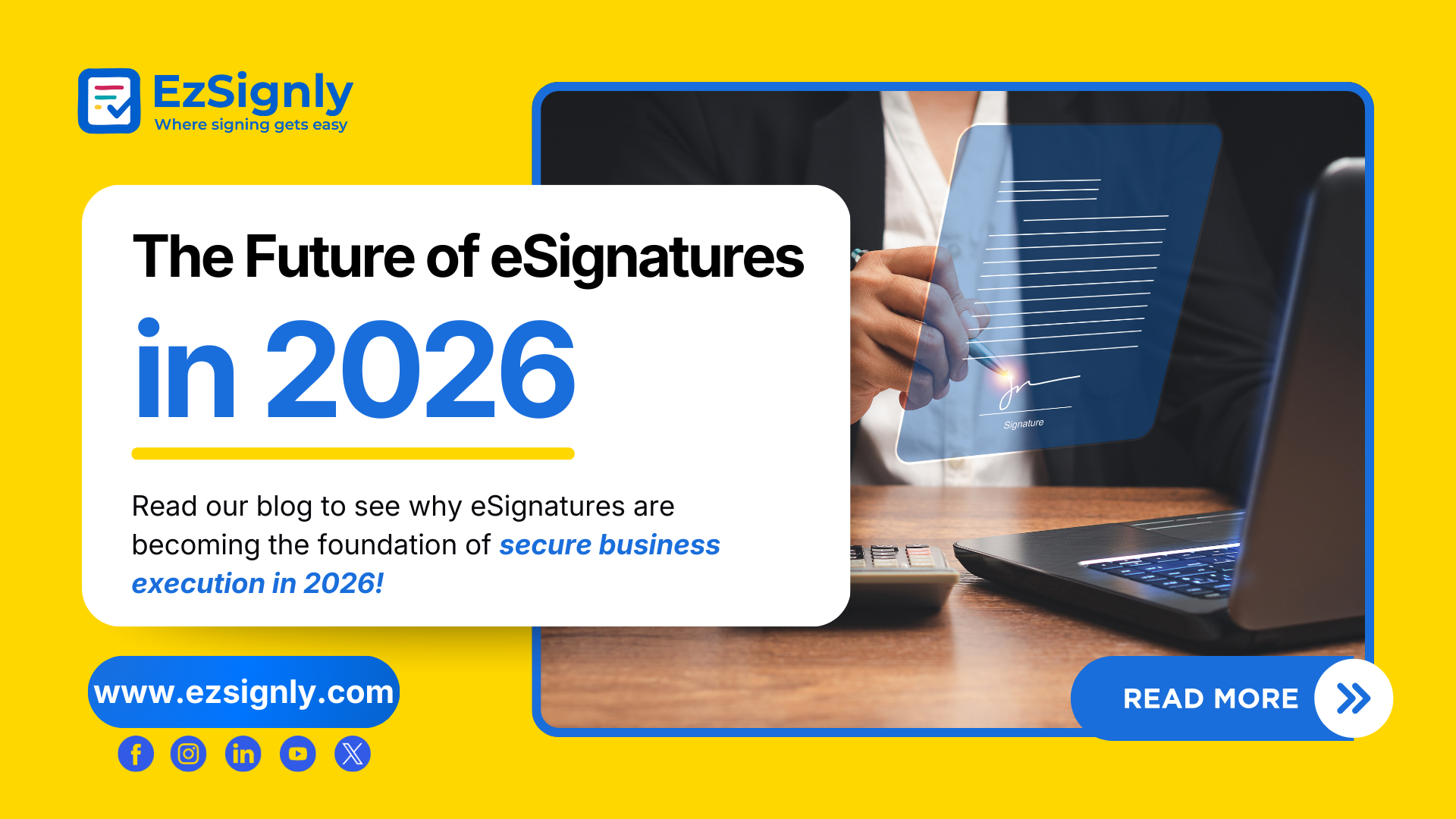
The Future of eSignatures in 2026: How EzSignly Is Redefining Digital Trust
January 27, 2026 | Posted By Admin
Electronic Signing Software
Software to sign documents digitally has become a foremost need for successful business operations. The more consideration is given to automated processes, remote employees, and virtual documentation for successful operation, the more formally the decision-making process is implemented in line with organizational needs.
It is no longer sufficient that digitally signing a document is simply faster and easier. It is a way of establishing identity, intent, integrity, and accountability in the digital world.
In 2026, e-signatures are more than a tool for greater efficiency. It has become an integral part of governance infrastructure, with platforms like EzSignly helping define, measure, and enforce digital trust.
Why do Businesses Sign Documents Digitally?
The presence of a physical entity with the individual's signature formed the predominant basis for the formation of trusts in previous business scenarios. To establish trust for a new business entity, the system must operate in line with the global environment.
Now, all documents are automatically classified under the organization’s compliance posture or risk profile upon signing. Recruiting efforts, commercial agreements, procurement, and even acknowledgements with the regulators all require defensible statements.
When organizations sign documents digitally, they're doing much more than filling out a form with signatures on it. They create permanent records of business decisions that are auditable under different circumstances.
That is why digital trust is no longer a theory but a practical imperative for "scaling up."
Advantages of Signing Documents Electronically
- Time and Efficiency: Electronic signing speeds up every approval. Documents are completed in minutes instead of days. Workflows move without manual delays.
- Cost Savings: Printing and courier expenses are eliminated. Storage and administrative costs are reduced. Overall document processing becomes far cheaper.
- Security Benefits of Electronic Signatures: Electronic signatures protect documents with encryption and tamper-proof sealing. Every action is recorded in an audit trail. This makes documents more secure than paper.
- Improved Accessibility: Documents can be signed from any device. Location is no longer a barrier and remote teams work without disruption.
- Save Time and Money: Faster execution reduces operational overhead. Fewer manual steps lower processing costs. Both time and money are saved on every document.
- Grow Your Business with eSign: Approvals happen faster. Deals close sooner. Growth is no longer slowed by paperwork.
Why Digital Trust Now Drives Platform Selection
While the use of eSignatures is becoming more mainstream, the ability to be different rests on the digital trust factor.
Increasingly, organizations are considering whether the platform can reliably verify who signed the document, when it was signed, what version of the document was approved, and if it had changed since the signature.
Digital trust involves identity verification, digital sealing that is tamper-proof, completely traceable audit trails, and the reliability of the records over a period.
Those platforms to sign documents digitally that are unable to provide these guarantees, we find, would eventually be unsuitable for a highly regulated environment.
The Role of Pricing in Expanding Digital Trust
One of the key contributors to the universal application of eSignatures is their accessibility. Contemporary eSignatures pricing for Small Businesses uses a subscription model with freemium plans that allow small businesses to experience enterprise-grade features at minimal cost.
This has, therefore, transformed the nature of the market. Digital trust is no longer owned by large companies; it is embedded in every startup, every small business, every mid-sized company.
By 2026, the ability to sign documents digitally is an expected part of any business transaction.
HR as a Primary Driver of Trust-Based Execution
Human resources is one of the first departments to experience the governance impact of digital signing. Various contracts such as employment contracts, policy
acknowledgments, compliance forms, etc., have to be legally executed appropriately. In case of any error during these processes, risk may arise.
With eSignature for HR operations, organizations can now consider hiring and employment-related documents as a business process rather than an administrative task.
Platforms: In the year 2026, there will be a continuation of integration with eSignatures platforms; i.e., platforms that automate document generation, transmission, and archiving.
In this case, the role of the HR department changes from being simply a document-handling department to one where the role is determined by digital information, which appears to be the case for the development of the digital HR department.
From Signed Document to System of Record
One of the most notable trends for the future of eSignatures is their position as a system of record.
Signed agreements are no longer static files. They are digital objects with associated metadata, history, and evidentiary qualities.
This helps an organization measure their approval time, monitor compliance, as well as implement policies. You can keep track of turnaround time to sign documents digitally, get approvals and close deals.
It is at the heart of the way digital trust is operationalized in 2026.
Security Measures as the Foundation of Trust
With the rising concern about cyber risk, security architecture has become a key consideration in the process of selecting an eSignature solution.
Encryption, access control, document sealing, and detection of tampering have become compliance requirements in many places.
Platforms that must be future-ready need strong cryptography, access control, immutable audit trails, as well as preservation to sign documents digitally.
Digital trust in 2026 is built on security engineering, not interface design.
This is one of the areas where EzSignly continues to focus its product strategy.
How EzSignly Is Redefining Digital Trust
EzSignly is designed around the principle that execution is a governance function.
It treats signing as a controlled process rather than a convenience feature. Every workflow is trackable, every document is sealable, and every signature is verifiable.
This also enables standardization across the organization's departments for execution while maintaining compliance, security, and operational consistency.
This is an approach that, in 2026, mirrors the expectation of organizations when it comes to signing documents digitally.
Real Estate and the Maturity of Remote Execution
Real estate provides a clear illustration of how digital trust has matured.
Property transactions involve high-value assets, multiple parties, and strict legal requirements. They are also increasingly executed across locations.
The ability to eSign Real Estate Documents Digitally has removed geography as a constraint on legally binding execution.
In 2026, digital execution is no longer a competitive advantage in real estate. It is a baseline expectation of buyers, sellers, brokers, and regulators.
This normalization indicates that digital trust has reached institutional maturity.
The Integration of eSignatures into Core Systems
Another definitional trend is the depth of integration with existing infrastructure. eSignatures are now integrated into HR tools, CRM, ERP, Procure-to-Pay, etc.
Documents are created, signers are routed, and documents are stored in archives automatically without human intervention.
In this model, signing becomes an invisible but essential part of automation. When a software to sign documents digitally gets integrated with your existing tech stack, agreements and contracts move swiftly through the pipeline.
Regulation Needed To Sign Documents Digitally
This makes regulatory pressure one of the strongest forces to shape the adoption of eSignatures.
Data protection legislation, labor laws, financial regulations, and various industry requirements all make demands for accurate records of execution.
By 2026, compliance teams increasingly treat eSignature platforms as compliance infrastructure, rather than productivity tools.
Those platforms unable to demonstrate audit readiness or long-term evidentiary reliability will find it difficult to remain viable in regulated markets.
Have any other questions? EzSignly's team is here to help!
The Future of Digital Trust
eSignatures in the future are about trust, governance, and reliability.
Through organizations’ e-signing of such documents to create decision-making traces that hold up to scrutiny by both regulators and operations personnel.
They assess eSignature pricing options for Small Business in order to build digital trust in their organization.
They use eSignature in HR Operations in order to manage hiring and employment processes.
They eSign Real Estate Documents Digitally to remove location from legally binding execution.
They choose EzSignly because the next phase of digital transformation depends not only on automation, but on systems that can be trusted at scale.
In 2026, digital trust is no longer a competitive advantage. It is the foundation of how modern organizations operate.
Take a look at the latest blog

The Real Reason Your Business Is Losing Deals: Slow Document Signing in the USA
Slow document signing is costing U.S. businesses deals—every delay risks lost clients and missed opportunities
March 26, 2026
How to Eliminate eSignature Traditional Workflow Issues With Top AI Features: Book a Demo
Eliminate eSignature workflow bottlenecks with AI. Book a demo to see faster, smarter, and more efficient signing.
June 26, 2026
AI-Powered eSignatures in 2026: The Smart Choice for Modern Businesses
AI-powered eSignatures in 2026 make document signing faster, smarter, and more secure for modern businesses.
April 10, 2026
Understanding the Role of AI and Automation in eSignature Software in 2026
AI and automation in eSignature software improve security, speed, and accuracy by enabling smart verification and automated signing workflows.
February 20, 2026
Have any other questions? EzSignly's team is here to help!
© 2026 Copyright EzSignly. All Rights Reserved