


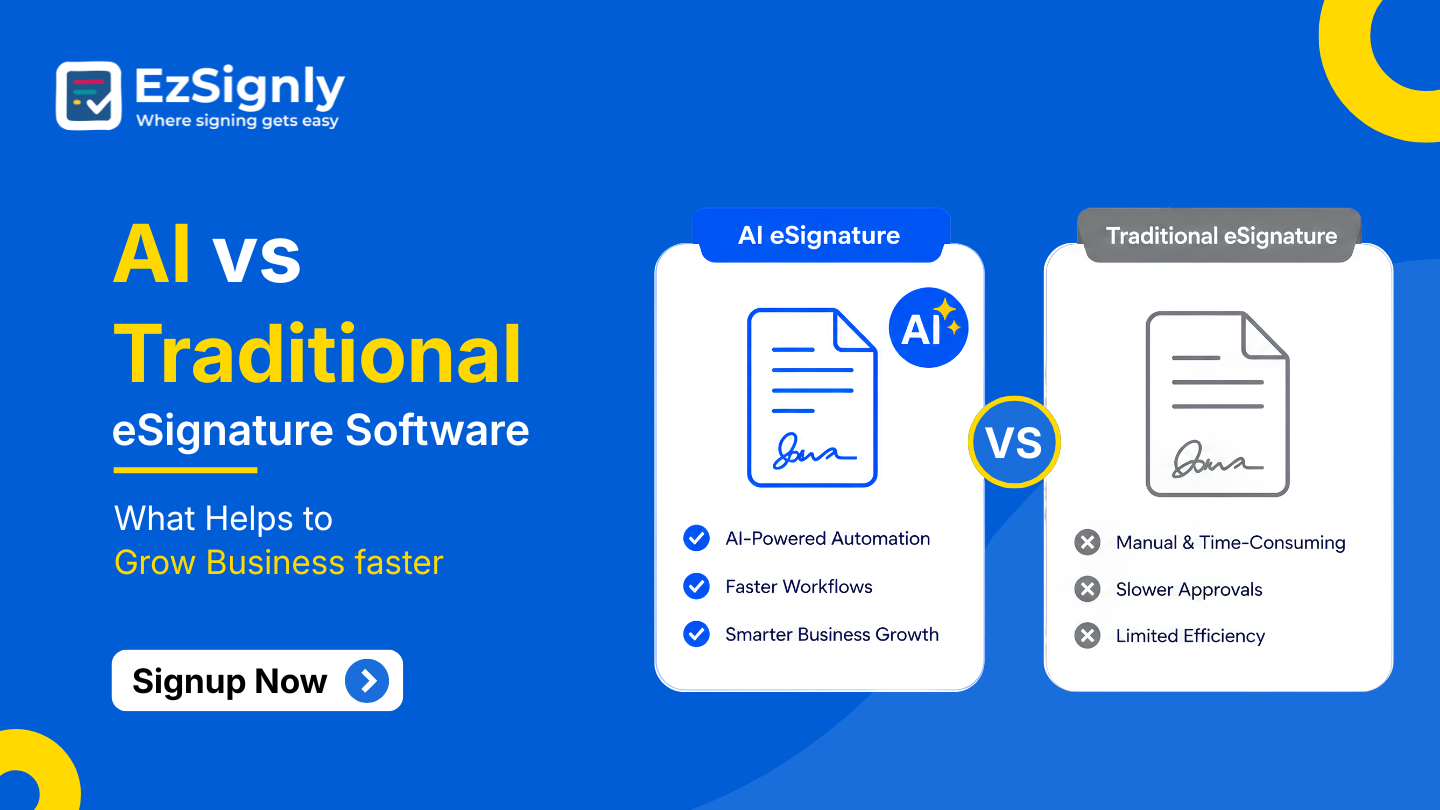
AI vs Traditional eSignature Software: What Helps to Grow Business faster: Signup Now
August 11, 2026 | Posted By Admin
Sign Documents Online for Free
Summary
AI electronic signature versus conventional
e-signature. For US small and medium companies, this is the key question. See
what kind of e-signature software makes sense to your business with an aim to
save time, simplify workflows, reduce administrative workload, and accelerate
growth at a faster pace.
Introduction
Speed is money for a growing business. An employee
signing sales agreements in a slow workflow can be put off by something like
pending vendor agreements or even employee onboarding documentation, both
ultimately costing the company revenue as they hang out in an email inbox or
approval queue. The eSignature market isn't just new, however. Agreements are
signed at a business rate with the software, which provides an eSignature
solution for small business to send, sign, and manage the document
workflows all without copying, signing, scanning and returning, or following up
via email with reminders. The answer to this depends on your timeline for
business growth and how much of your workflow you want to automate.
Easy eSignature Software for Fast and Secure Document Signing
eSignature software for years was known for taking an outdated pain point for businesses away - physically getting documents signed. Forget all the tedious paperwork and confusing signing process - upload your document to our eSignature solution, set signature areas, fill in recipients, and send it out for signature. Once you sign it, you will immediately get the signed document back. This is important for SMBs because the above features are incredibly easy to use with eSignature. You send it out, and someone clicks to sign. That's all. There's no onboarding.
You would probably be expecting that the vast majority of established e-signature solution providers have some basic e-signature functions - such as templates, signature pages, tracking documents, automated reminders, the full auditable log, and securely storing your documents. Businesses will be able to request an e-signature, know the status of a document being signed, retrieve the audit logs, and have them integrated into their business applications (Teams, Salesforce).
For a business that signs only a couple of contracts
each week, this functionality may be all that it needs. Unfortunately, most
eSignature solutions out there have been designed to manage just one aspect of
the whole process: the signed document. However, on either end of that, a whole
spectrum of business and customer interactions exists. This includes everything
from what to send and who signs to how it's reviewed and how to account for
deviations, among other factors. This is where smart tech becomes important.
Transform Business Workflows with Smart Digital Signature Technology
And electronic signature version 2 will look nothing like your current tool. It won't be about just getting the signature anymore. If you add a technology that can read contracts, know the content and date of documents, help with operational queries, and reduce operational back-office tasks, you get an answer that looks like this. Other digital signing platforms available online have evolved from being electronic signing companies to becoming intelligent agreement management companies, using technology to help businesses manage agreements, ingest data from them, handle renewals, and identify valuable insights.
The company also added intelligent features to the
rest of its document universe, with tools capable of producing summaries and
helping readers uncover knowledge from PDFs. For an SMB, that kind of
functionality is important because the challenge isn't often the signature
itself. The biggest issue often has to do with whatever else is happening
around the signature. Think about a company of 30 individuals where you welcome
five new hires all at the same time in the same month. You have an offer
letter, an employment agreement, a non-disclosure agreement, a handbook
acknowledgement, and so many other documents to push out. The platform for
signing those documents can streamline the process. A more intelligent workflow
can reduce some of the manual work that comes with those documents and, for
larger companies, can make a significant difference.
Compare Smart and Traditional Digital Signature Software
SMBs most commonly use digital signatures for their time-saving benefits. But speed isn't only the number of hours it takes to get a document signed. The whole process, from drafting an agreement to executing it, is what we mean by speed.
| Business Need | Traditional eSignature | AI-powered eSignature |
| Send the document digitally | Basic | Excellent |
| Collect Signatures | Basic | Excellent |
| Templated | Common | AI-enabled formats |
| Automated Reminders | Available on many platforms | Available with smarter workflow capabilities |
| Document Monitoring | Yes | Yes |
| Audit Trails | Yes | Yes |
| Document Information extraction | Limited or platform-dependent | More Advanced |
| Workflow Automation | Basic to Advanced | More Intelligent or contextual |
| Agreement Insights | Limited | More Advanced |
| Best For | Straightforward signing | Growing, process-heavy businesses |
| Scalability | Good | Strong for complex workflows |
If your business mainly relies on capturing digital
authentications and managing document workflows, then traditional software can
certainly still work. But intelligent software starts to sense when your
employees are consuming so much time on creating a document, vetting data,
chasing down approvals, or overseeing hundreds of contracts, for instance. In
other words, the victor won't be whoever has the most intelligent tech. But
whoever solves for business friction the best.
Beyond Digital Signatures: Smarter Workflows for SMBs
The biggest mistake companies make is thinking of digital signature software as just the pen part of signing. The signature isn't the whole story; it's one element. There's document preparation before the signature, sending to the correct people, filling out required fields, perhaps getting approvals, and even tracking and filing afterward, sometimes as long as years in the future.
It also looks like modern platforms increasingly focus on this entire lifecycle. Many have features that go beyond digital signature features, like the reusable templates, automated signing workflows, bulk sending, live tracking, team collaboration, and secure audit trails emphasized in EzSignly. Other online signature platforms are the behemoths, evolving even further beyond the standard signature with the full spectrum of agreement management, integrations, analytics, and intelligent documents.
For SMB owners, eSignature software for real
estate in US is simple: choose technology based on the business
problem you want to solve, not simply the number of features displayed on a
product page.
Why Smarter eSignatures Matter for Growing SMBs
Expansion leads to more forms, new customers lead to more agreements, more staff lead to more HR paperwork, and more suppliers lead to more supplier agreements. And moving to that area typically means you also have to handle a range of compliance and logistical paperwork. But in a less structured, manual setup, the time it takes managing these claims and payments can eat up your revenue if you're not careful.
A smarter eSignature workflow can help businesses address several common roadblocks:
- Faster document preparation: Reusable templates reduce repetitive setup.
- Less manual follow-up: Follow-up timings can be saved. No chasing signing recipients. If you automated the follow-up.
- Better visibility: Teams can see whether documents are pending, viewed, signed, or completed.
- Improved organization: Digital records make agreements easier to locate and manage.
- Reduced administrative workload: Automated workflows can handle repetitive steps.
- Better customer experience: Customers can complete agreements from their preferred device.
- More consistent processes: Standardized templates and workflows reduce unnecessary variation.
To that end, EzSignly structures its service with
SMB-oriented pricing, templates, signing workflows, bulk signing, tracking,
security, and automation for businesses in the U.S. They're especially
beneficial to businesses that lack a big administrative/operational department.
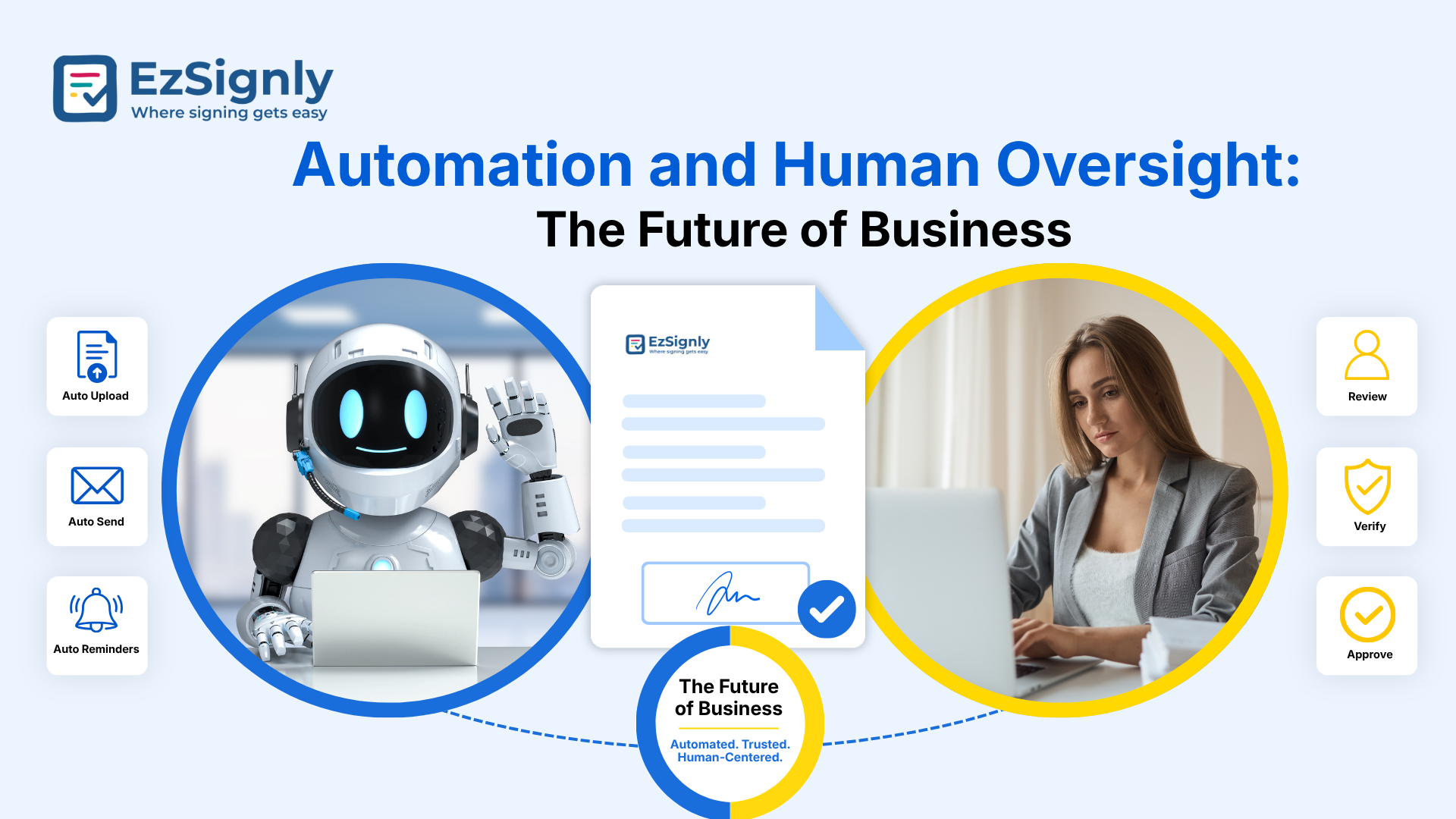
Automation and Human Oversight: The Future of Business
AI shouldn't be interpreted as an automatic prompt for companies to eliminate humans from critical decision-making tasks. Contracts, hiring agreements, financial statements, and legal documents are often riddled with sensitive or commercially sensitive information that necessitates human review and a decision-making role, including checking and verifying.
Sign Documents Online for Free
The best system is to have your software handle the routine tasks while you make the decisions. Let your program handle reminder emails, route documents, monitor statuses, archive files, and find data, but let a human make the judgment calls, negotiate, provide context, and take responsibility. Together, they can help businesses grow at a proportional rate without scaling the administrative overhead proportionally.
Industry Use Cases: Where the Difference Becomes Clear
The value of intelligent eSignature software becomes easier to understand when looking at specific SMB departments.
HR and Employee Onboarding
Hiring teams often work against tight deadlines. When a candidate finally receives a job offer and accepts it, HR must act quickly.
This reduces business processes from multiple outgoing documents and manual follow-up to a unified experience with templates, signing sequences, automated reminders, and built-in tracking. For businesses looking specifically at regional human resource workflows, an option such as the HR software in the areas of Chicago can be relevant when standardizing employee documentation and approval processes.
Legal and Compliance Documents
Legal documents need to be accurate, consistent, and auditable. From contracts and agreements to disclosures and more, most business documents will require several parties to review and approve before being signed. Digital signing helps document this process and includes an audit trail that tracks all signing activity. Businesses should be sure to investigate the legal and compliance guidelines that apply to their specific documents and jurisdiction.
For organizations handling regional legal workflows, eSign Legal Doc in Chicago can support the broader move from manual document handling to structured digital signing.
Real Estate and Sales
Real estate businesses can benefit significantly from faster agreement cycles. Reviewing and signing documents can be a necessity for agents, brokers, buyers, sellers, landlords, tenants, and even service providers. Tracking documents linked to multiple parties is especially useful during ongoing transactions.
For businesses operating across the country, eSignature
software for real estate in US can help support digital signing
workflows across property-related transactions. The same goes for sales teams.
This is the moment a lead is ready to sign, and friction is the last thing you
want to introduce; instead, you should create a moment of pause and allow the
signature.
How Small Businesses Can Choose the Correct Document Signature
There is no universal winner between traditional and intelligent eSignature software. If your business sends a handful of documents each month, a straightforward platform may be sufficient. You probably don't need high-level document analytics, intelligent process automation, or even automated task management. Yet if you're handling dozens, hundreds of documents, dealing with different departments, and chasing up clients and employees time after time, intelligent automation could seriously add value.
You should consider five questions:
1. How many documents does your company process each month?
2. How much employee time is spent preparing and tracking them?
3. How often do documents require multiple signers?
4. How important are templates, automated reminders, and workflow rules?
5. Will your signing volume increase as the company grows?
If the answers point toward increasing document volume
and administrative complexity, investing in a scalable eSignature platform
makes sense.
Conclusion
Electronic signature software has come a long way and is already helping companies across the US become paper-free and streamline document management and execution. And intelligent eSignature is stepping it up, helping companies automate workflows, manage contract data, take on less tedious tasks, and keep everything in sight. The sweet spot for SMBs will involve a platform that fits current needs while keeping future potential in mind - sometimes a smooth signature process suffices, while automation capacity might be priceless to grow. The goal is not simply to collect signatures faster. It is about creating a business process that keeps moving.
Sign Up Now and Grow Your Business Faster
Have any other questions? EzSignly's team is here to help!
FAQs
1. Is intelligent signing software better than traditional software?
A: Not always. Traditional document signature software can be ideal for businesses with simple signing requirements. AI platforms become more useful when an SMB needs advanced automation, document insights, complex workflows, or higher-volume agreement management.
2. Can electronic signature software help a small business save time?
A: Yes. Digital signing can eliminate copying, scanning, sending to the recipients, and manual document handling. Features such as reusable templates, automated reminders, tracking, and workflow automation can further reduce administrative work.
3. What should US SMBs consider before choosing an online signature platform?
A: Consider security, audit trails, ease of use, templates, integrations, workflow automation, scalability, pricing, mobile signing, and the types of documents your business handles. Also evaluate whether the platform can continue supporting your processes as your company grows.
Take a look at the latest blog
The Future of eSignatures in 2026: How EzSignly Is Redefining Digital Trust
EzSignly leads the 2026 eSignature era with smarter security and digital trust.
January 27, 2026
How AI-Powered eSignature Features Improve Secure Document Management
AI-powered eSignatures enhance document security by verifying identities, preventing fraud, and providing secure audit trails.
March 5, 2026

Common E-Signature Mistakes (And How to Avoid Them)
An e-signature is a promise. But a simple mistake can make that promise legally worthless. I’ve seen businesses lose deals over errors that were easil...
December 31, 2025

eSignature Software Trends Every Business Sector Is Using with EzSignly in 2026
In 2026, businesses across industries use EzSignly to enable secure, AI-powered, and fully paperless digital document signing with seamless system int...
February 11, 2026
Have any other questions? EzSignly's team is here to help!
© 2026 Copyright EzSignly. All Rights Reserved